Document Forgery
Document Forgery and Scientific Document Examination

Document Forgery Examination
Document forgery examination is carried out with the help of optical instruments and devices to establish whether documents with high-security features, such as identity cards, passports, visas, cheques and banknotes, are counterfeit, or whether the information on them has been fraudulently altered.
- Official Document Examination High-security documents such as identity cards, passports and visas.
- Negotiable Instrument Analysis Detection of forged cheques, promissory notes (senet) and counterfeit banknotes.
- Alteration Detection Optical analysis of tampering and changes made to documents.
Why Work With Us?
If you need an experienced, qualified forensic document examiner in Turkey, you are in the right place.
- Have you been the victim of forgery or fraud in Turkey?
- Do you believe someone forged your signature?
- Has a promissory note, cheque, contract or other document been forged in your name?
- Do you doubt whether a signature on a document you received is genuine?
I have been working on forgery and fraud cases since 1995. With 30 years of experience and specialised equipment, I am ready to help you.
Legal Framework and Reference Sources for Document Forgery Examination
Document forgery examination is one of the core scientific methods of proof used in Turkish criminal and civil cases in which the authenticity of documents such as identity cards, passports, cheques, promissory notes and banknotes is challenged. The legal provisions and institutional sources below form the legal basis of this examination.
-
Turkish Criminal Code (TCK) Article 204 — Forgery of Official Documents
Falsely producing or altering official documents such as identity cards, passports and visas carries a prison sentence of 2–5 years; where the offence is committed by a public official, the sentence is 3–8 years.
Read the Statute -
Turkish Criminal Code (TCK) Article 207 — Forgery of Private Documents
Falsely producing private documents such as promissory notes and contracts, or altering and using them, carries a prison sentence of 1–3 years.
Read the Statute -
Turkish Criminal Code (TCK) Article 197 — Counterfeiting Money
A person who counterfeits money that is legal tender, or brings it into the country, transports or keeps it, is punished with 2–12 years’ imprisonment and a judicial fine.
Read the Statute -
Code of Civil Procedure (HMK) Article 293 — Expert Opinion
The parties may obtain a scientific opinion from an expert on the matter in dispute (HMK 293(1)). The judge may, on request or of their own motion, decide to hear the expert who prepared the report (HMK 293(2)).
Read the HMK -
Code of Criminal Procedure (CMK) Article 67(6) — Expert Opinion
The public prosecutor, the intervening party and their representative, the suspect or accused, defence counsel or legal representative may obtain a scientific opinion from an expert concerning the subject of the proceedings, for evaluation in the preparation of the court expert’s report, or about that report.
Read the CMK -
Turkish National Police — Criminal Laboratories
The Criminal Police Laboratories Department of the Turkish National Police carries out document forgery examinations in an official capacity.
Visit the Police Source
Our Credentials in This Field
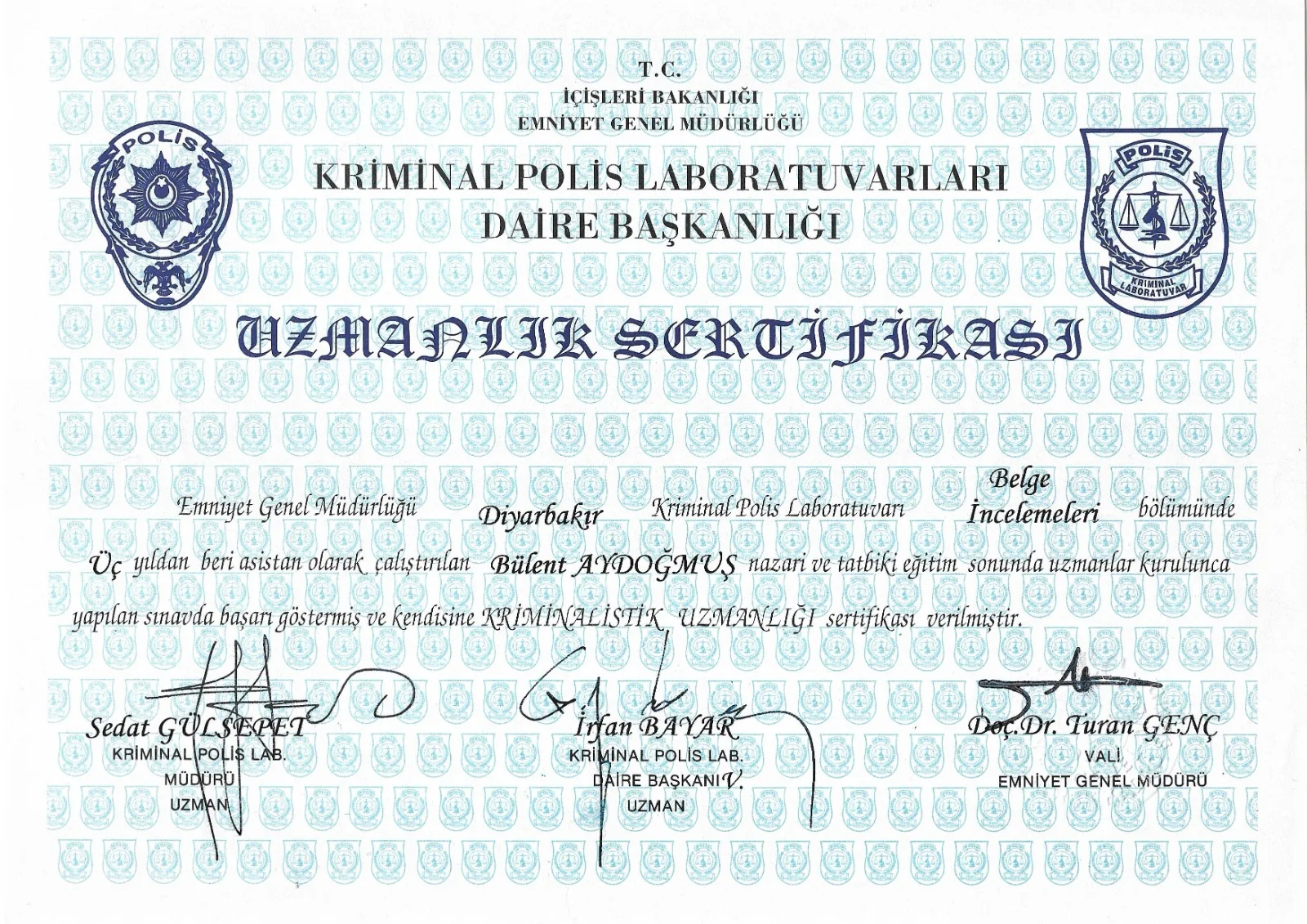
Criminalistics Expertise Certificate (Document Examination)
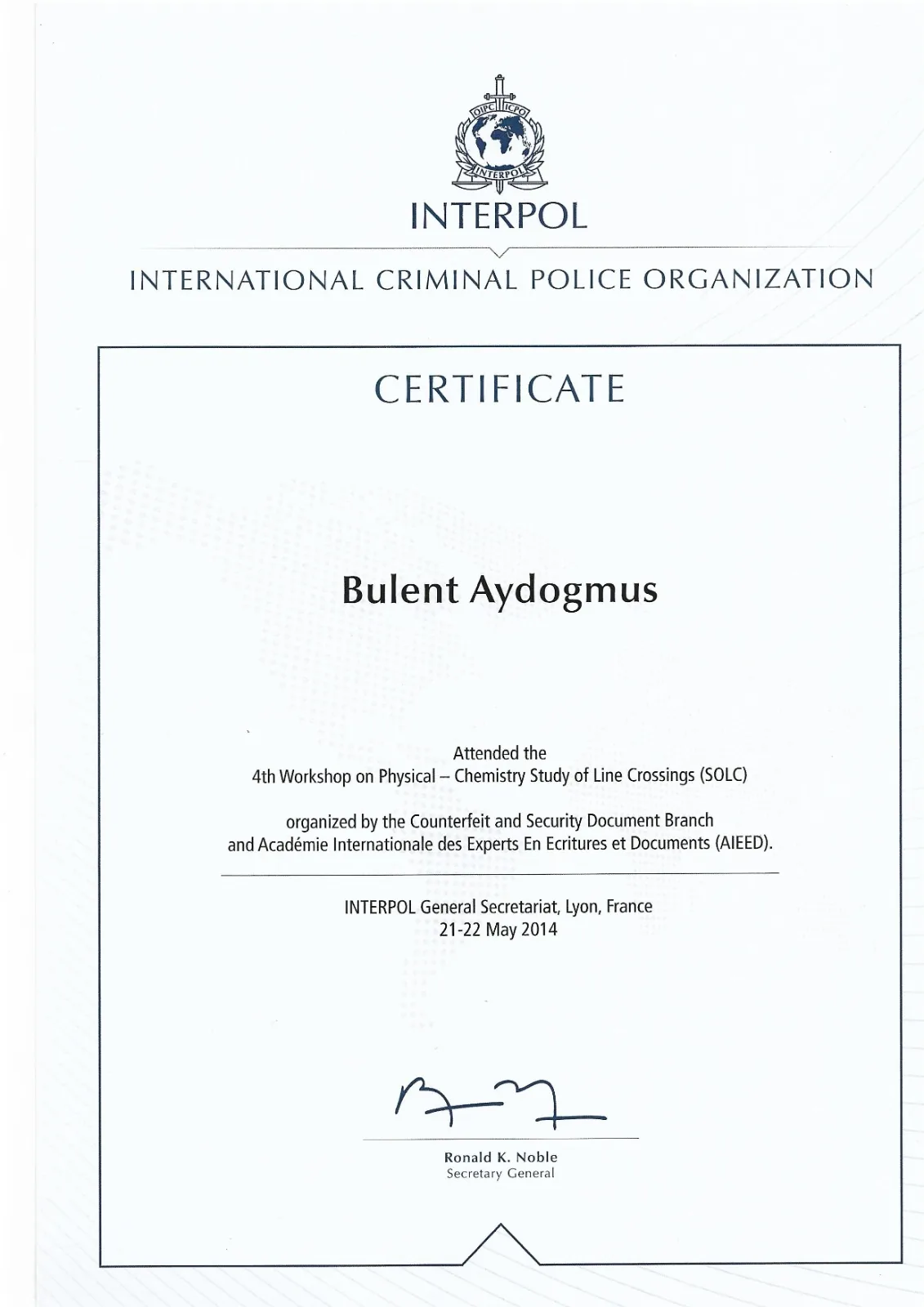
INTERPOL 4th Workshop on Physical–Chemistry Study of Line Crossings (SOLC)
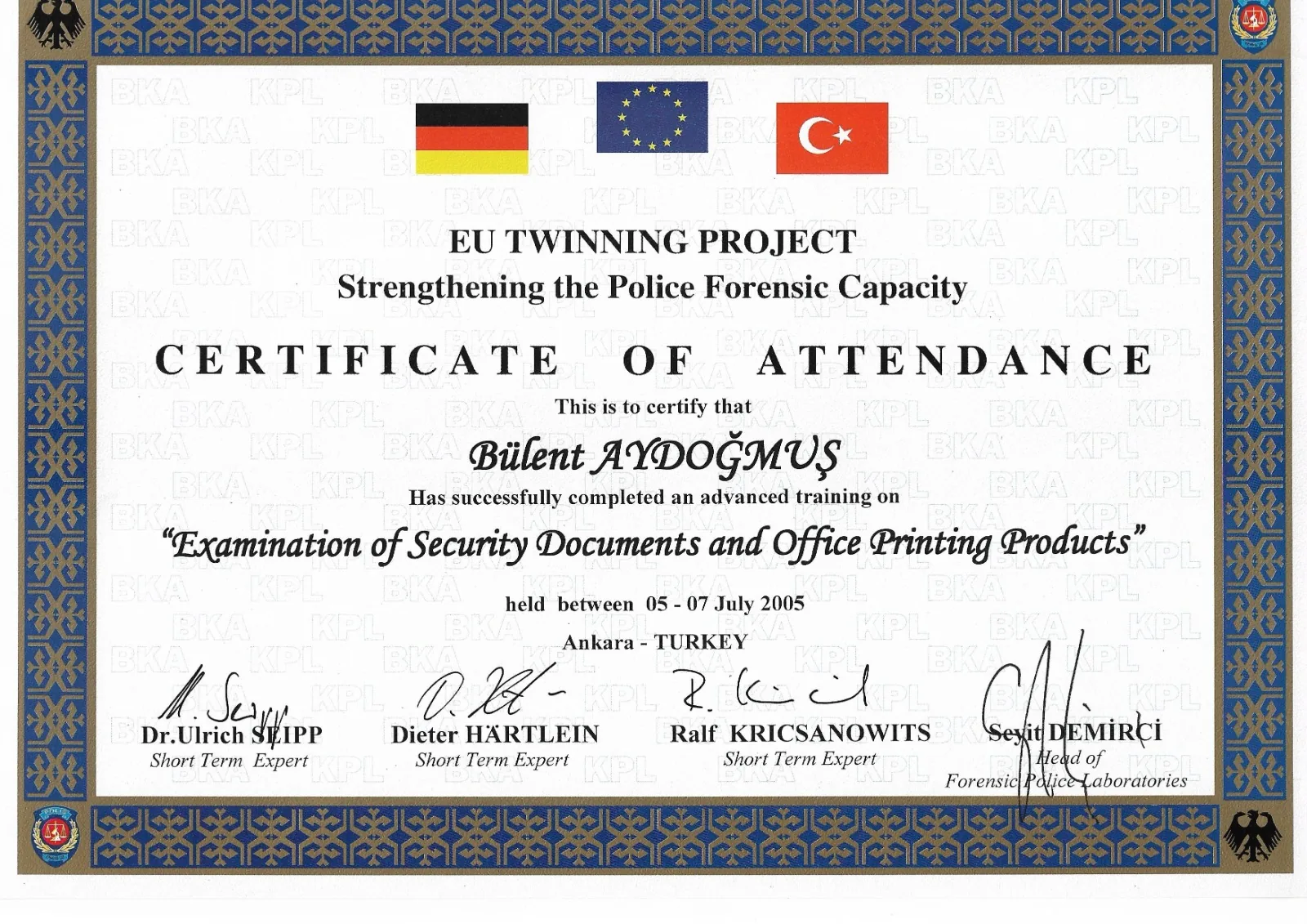
EU Twinning Project: Examination of Security Documents and Office Printing Products
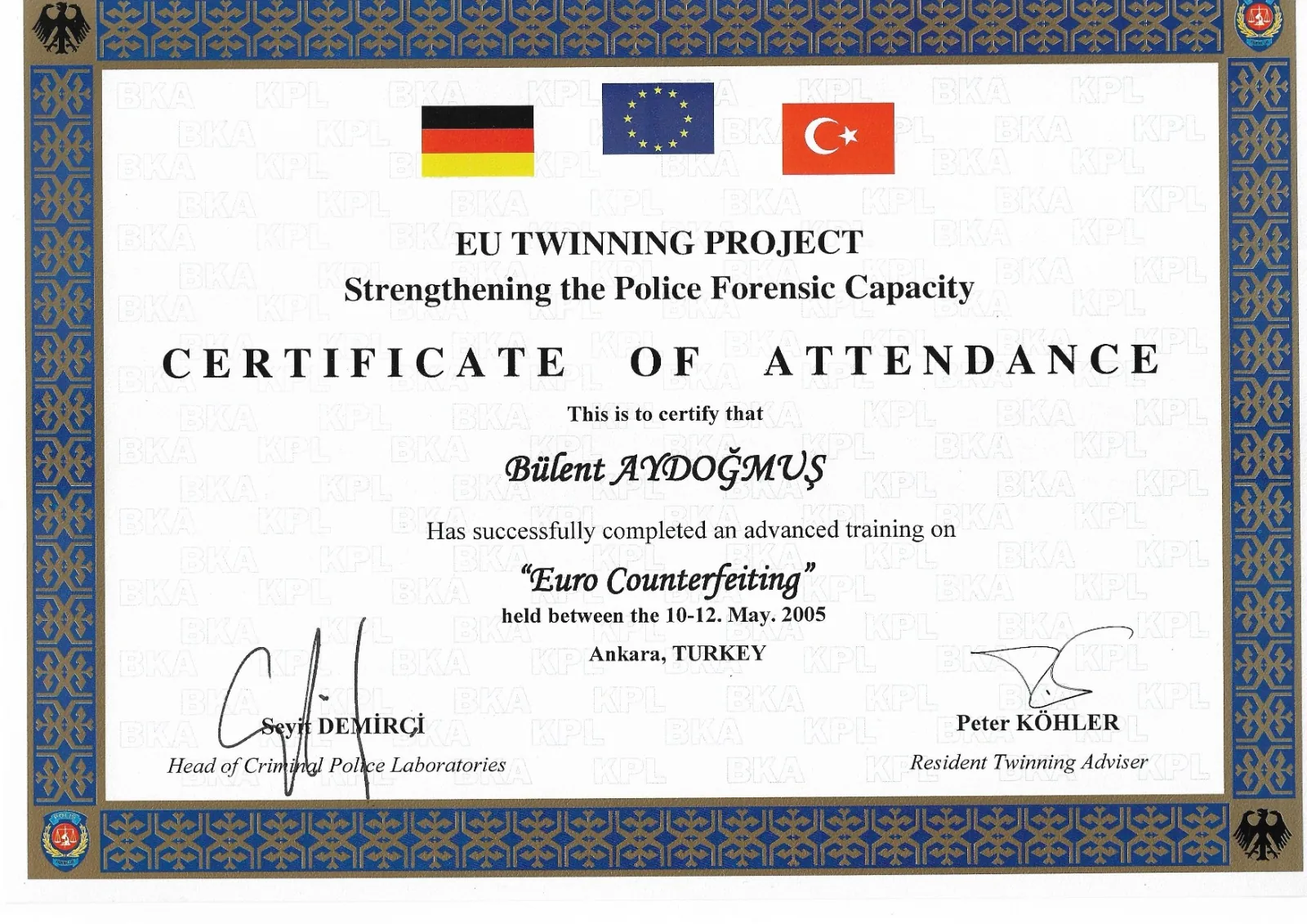
EU Twinning Project: Euro Counterfeiting Training
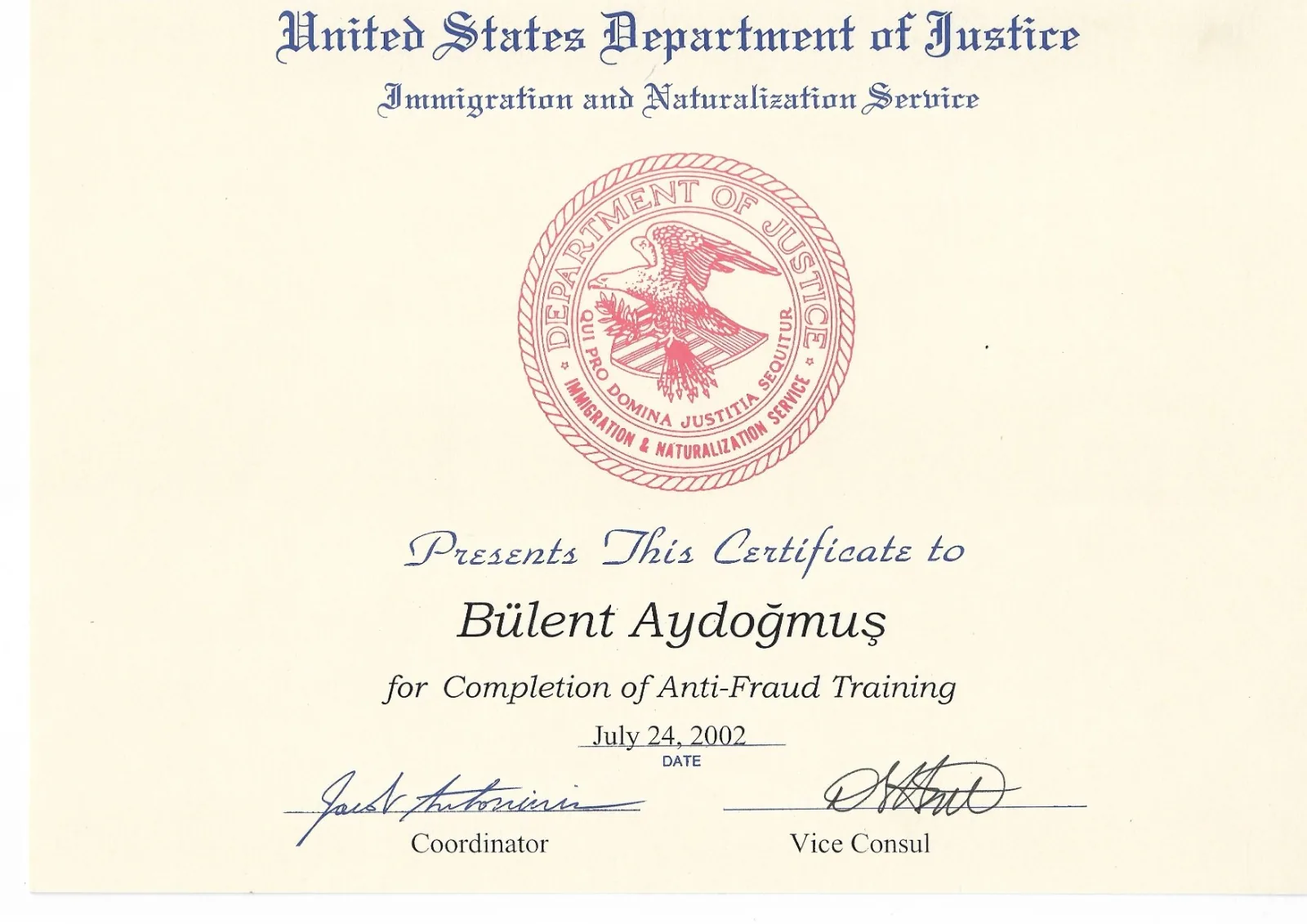
U.S. Department of Justice INS Anti-Fraud Training