Document Alteration Examination and Forgery Detection
Scientific Proof of Erasures, Scrapings and Additions on Documents Using Advanced Technology Instruments
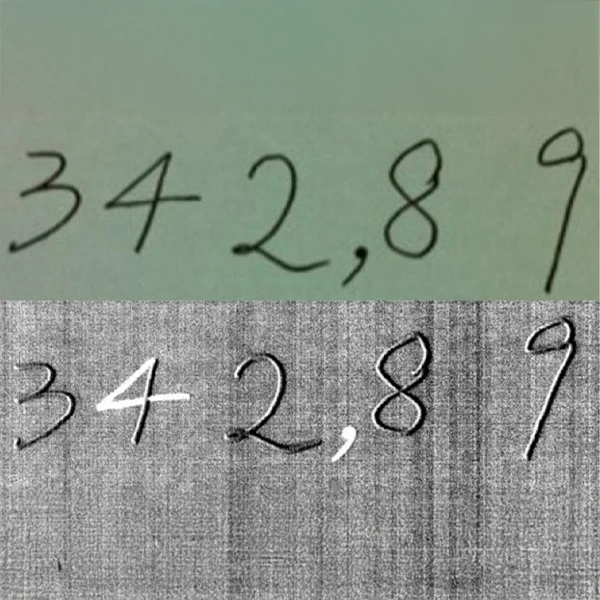
Details Invisible to the Eye: In the example above, figures that look normal to the naked eye are scientifically shown, under forensic light sources, to have been altered and tampered with at a later stage.
Document Alteration Examination and Forgery Detection
Alteration (tampering) means changing the meaning of a document by erasing, scraping, adding to or chemically interfering with the original. Changes made to the amounts on promissory notes (senet) in particular (e.g. turning TRY 3,000 into TRY 8,000), or clauses added to contracts afterwards, are detected with the special light sources and microscopic examination used in our laboratory.
Technological Detection: Damage to paper fibres (scraping) or the different reactions of pen inks to light (additions) are documented with Video Spectral Comparator (VSC) instruments as "conclusive evidence".
- Erasures and Scrapings Removal of writing on a document by mechanical (blade, eraser) or chemical means.
- Additions Changing the meaning by adding figures or letters to the existing writing afterwards.
- Page Substitution Analysis of whether intermediate pages of multi-page contracts have been replaced.
Why Work With Us?
If you need an experienced, qualified forensic document examiner in Turkey, you are in the right place.
- Have you been the victim of forgery or fraud in Turkey?
- Do you believe someone forged your signature?
- Has a promissory note, cheque, contract or other document been forged in your name?
- Do you doubt whether a signature on a document you received is genuine?
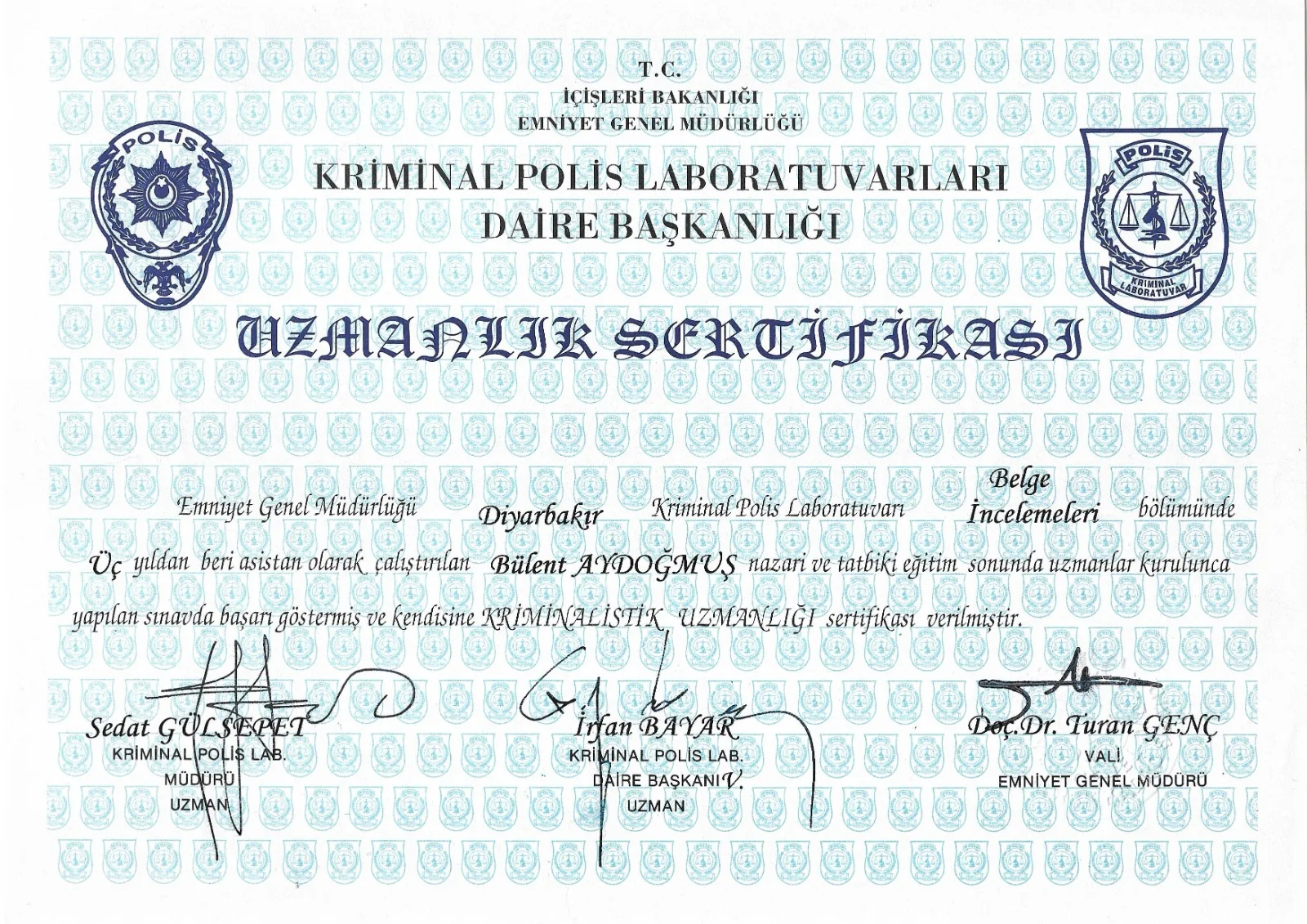
I have been working on forgery and fraud cases since 1995. With 30 years of experience and specialised equipment, I am ready to help you.
Legal Framework and Reference Sources for Alteration Examination
Document alteration means changing the meaning of a promissory note, contract or official document by scraping, erasing, adding to or chemically interfering with it. The Turkish Criminal Code (TCK) imposes severe penalties for these acts. A scientific alteration report can be filed with the case and is evaluated by the court together with the other evidence.
-
Turkish Criminal Code (TCK) Article 204 — Forgery of Official Documents
Alteration of an official document by scraping, erasing or later additions carries a prison sentence of 2–5 years. Where the offence is committed by a public official, the sentence rises to 3–8 years. Under TCK Article 210, these provisions also apply to bills of exchange and promissory notes payable to order or bearer.
Read the Statute -
Turkish Criminal Code (TCK) Article 210 — Documents Treated as Official Documents
Where the subject of private document forgery is a bill of exchange or promissory note payable to order or bearer, a document of title to goods, a share certificate, a bond or a will, the provisions on forgery of official documents apply.
Read the Statute -
Code of Criminal Procedure (CMK) Article 63 — Appointment of Court Experts
Where a matter requires expertise or special or technical knowledge, the court may, of its own motion or at the request of the public prosecutor, the intervening party or their representative, the suspect or accused, defence counsel or legal representative, decide to obtain the opinion of a court-appointed expert.
Read the CMK -
Code of Criminal Procedure (CMK) Article 67(6) — Expert Opinion
The public prosecutor, the intervening party and their representative, the suspect or accused, defence counsel or legal representative may obtain a scientific opinion from an expert concerning the subject of the proceedings, for evaluation in the preparation of the court expert’s report, or about that report.
Read the CMK -
Turkish National Police — Criminal Laboratories
The Criminal Police Laboratories Department of the Turkish National Police carries out alteration detection in an official capacity using VSC instruments and spectral analysis methods.
Visit the Police Source -
ENFSI — European Network of Forensic Science Institutes
The European Network of Forensic Science Institutes is Europe’s leading forensic science umbrella organisation, setting the spectral analysis and VSC methodology used in alteration detection.
Visit ENFSI
Frequently Asked Questions About Document Alteration
What is document alteration?
Document alteration is the later modification of the writing, figures, date or signature on a genuine document. It is done by erasing, scraping, overwriting, adding or scribbling over entries, with the aim of changing the legal effect of the document, for example by adding a digit to the amount on a promissory note or changing its due date.
What is the difference between alteration and forgery?
In forgery the document is created as a fake from the outset or the signature is imitated. In alteration a genuine document is modified afterwards. Under Articles 204 and 207 of the Turkish Criminal Code, altering a genuine document in a deceptive way is also treated as document forgery.
How is document alteration detected?
The document is examined non-destructively with light at different wavelengths (UV/IR), oblique lighting and digital microscopy. These methods reveal how different inks react under light, damage to paper fibres, erased or covered entries and the sequence of writing.
Is the original document needed for an alteration examination?
Yes, a reliable examination requires the original. On a photocopy or scan, ink differences, traces of scraping and changes to the paper surface are largely lost. The document should not be folded, stapled or written on.