Printed Document Examination and Printer Identification
Determining Which Printer a Document Came From and Forensic Source Analysis
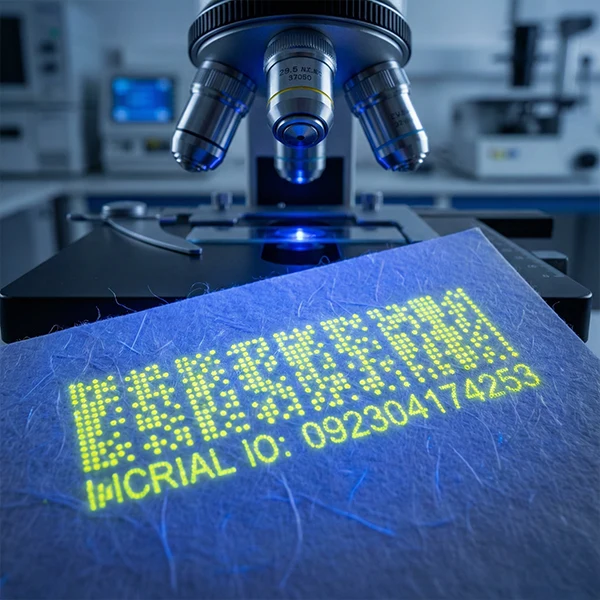
Invisible Traces: As the image shows, colour laser printers in particular leave “yellow dot patterns” on the paper surface that cannot be seen with the naked eye. These traces are a digital fingerprint that reveals which machine a document was printed on.
Printed Document Examination and Printer Identification
In our laboratory, printed text on one document is compared with printed text on another document to determine whether both were printed on the same computer printer, or compared with reference prints obtained from suspected printers to establish the source of the document.
By examining the printed text on a document (printing technology and toner/ink structure), it is also possible to determine what type of printer (laser, inkjet, etc.) was used.
Important: All of the results described above are possible only to the extent supported by the findings that can be established during the examination (class and characteristic features as well as accidental characteristics / trash marks).
- Source Identification Analysis of whether the document was printed on the suspected printer.
- Technology Analysis Microscopic differentiation of the printing technique (laser/inkjet).
Why Work With Us?
If you need an experienced, qualified forensic document examiner in Turkey, you are in the right place.
- Have you been the victim of forgery or fraud in Turkey?
- Do you believe someone forged your signature?
- Has a promissory note, cheque, contract or other document been forged in your name?
- Do you doubt whether a signature on a document you received is genuine?
I have been working on forgery and fraud cases since 1995. With 30 years of experience and specialised equipment, I am ready to help you.
Legal Framework and Reference Sources for Printed Document Examination
Printer source identification establishes scientifically which device digitally produced documents – such as forged invoices, forged contracts and identity documents – were printed on. Yellow dot (MIC) analysis and the detection of print defects are internationally recognised methods. The sources below form the technical and legal basis of these examinations.
-
TCK Article 204 — Forgery of Official Documents
Under the Turkish Criminal Code (TCK), forged official documents produced with a printer carry a penalty of 2–5 years’ imprisonment, or 3–8 years where the offence is committed by a public official.
View the Statute (Turkish) -
TCK Article 207 — Forgery of Private Documents
Forged contracts, written undertakings or other private documents produced with a printer carry a penalty of 1–3 years’ imprisonment. Printed document examination can conclusively establish the source of the document.
View the Statute (Turkish) -
EFF — Yellow Dot (MIC) Research
The Electronic Frontier Foundation was the first organisation in the world to document the invisible yellow dot patterns (Machine Identification Code) that colour laser printers leave on paper. These dots contain the printer’s serial number and the print date in encoded form.
View the EFF Research -
Code of Criminal Procedure (CMK) Article 67(6) — Expert Opinion
The public prosecutor, the intervening party and their representative, the suspect or accused, defence counsel or legal representative may obtain a scientific opinion from an expert concerning the subject of the proceedings, for evaluation in the preparation of the court expert’s report, or about that report.
Read the CMK -
Turkish National Police — Criminal Laboratories
The Criminal Police Laboratories Department of the Turkish National Police carries out printer source identification and printing technology analyses within its official capacity.
Go to the Police Source -
ENFSI — Digital Print Analysis Standards
The European Network of Forensic Science Institutes is the reference body that sets international standards for the toner analysis, print defect and MIC methodology used in printed document examination.
Go to the ENFSI Source