Stamp and Seal Impression Examination and Forgery Detection
Forensic Source Analysis and Expert Opinion on Questioned Stamps, Seals and Impressions in Documents
Stamp and Seal Impression Examination and Forgery Detection
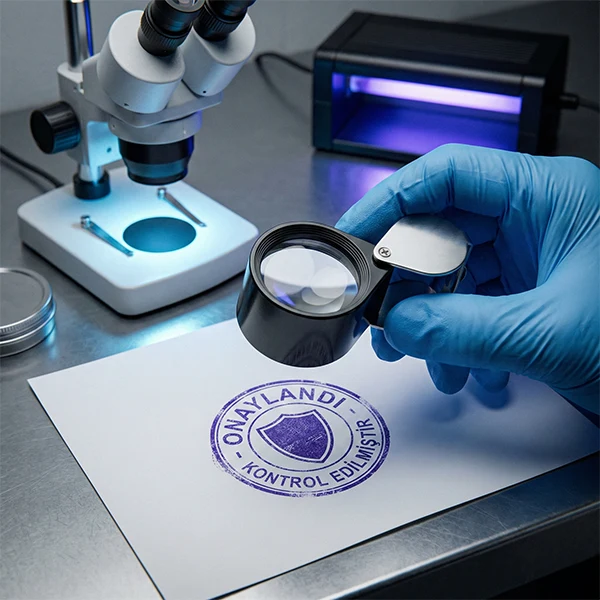
This is the examination of rubber stamp, seal and embossed (dry) seal impressions on official or private documents for signs of forgery. In our forensic laboratory, questioned stamp impressions are compared microscopically with reference (genuine) impressions in terms of rubber deformation, ink transfer defects, edge characteristics and manufacturing technique.
Like a Fingerprint: Every stamp rubber develops its own wear, chipping and contamination marks (accidental characteristics) over its period of use. These marks act as a “fingerprint” that reveals the identity of the stamp.
- Source Identification Determining whether the questioned impression was made with a specific stamp.
- Manufacturing Technique Analysis Distinguishing between laser engraving, photopolymer and conventional moulding techniques.
- Ink and Impression Analysis Examination of ink colour, distribution and penetration into the paper.
Why Work With Us?
If you need an experienced, qualified forensic document examiner in Turkey, you are in the right place.
- Have you been the victim of forgery or fraud in Turkey?
- Do you believe someone forged your signature?
- Has a promissory note, cheque, contract or other document been forged in your name?
- Do you doubt whether a signature on a document you received is genuine?
I have been working on forgery and fraud cases since 1995. With 30 years of experience and specialised equipment, I am ready to help you.
Legal Framework and Reference Sources for Stamp and Seal Impression Examination
Stamp and seal impression examination is one of the scientific methods of evidence used in commercial disputes, in cases where the authenticity of corporate documents is challenged, and in investigations into forgery of official documents. The statutory provisions and institutional sources below form the legal basis of this examination under Turkish law.
-
TCK Article 207 — Forgery of Private Documents
Under the Turkish Criminal Code (TCK), producing or using private documents bearing a forged stamp or seal impression is punishable by 1–3 years’ imprisonment.
View the Statute (Turkish) -
TCK Article 204 — Forgery of Official Documents
For official documents produced by imitating an institution’s seal or stamp, the penalty is 2–5 years’ imprisonment, or 3–8 years where the offence is committed by a public official.
View the Statute (Turkish) -
HMK Article 293 — Expert Opinion
The parties may obtain a scientific opinion from an expert on the matter in dispute (HMK 293(1)). The judge may, on request or of their own motion, decide to hear the expert who prepared the report (HMK 293(2)).
View the HMK (Turkish) -
Code of Criminal Procedure (CMK) Article 67(6) — Expert Opinion
The public prosecutor, the intervening party and their representative, the suspect or accused, defence counsel or legal representative may obtain a scientific opinion from an expert concerning the subject of the proceedings, for evaluation in the preparation of the court expert’s report, or about that report.
Read the CMK -
Turkish National Police — Criminal Laboratories
The Criminal Police Laboratories Department of the Turkish National Police carries out stamp and seal impression source examinations within its official capacity.
Go to the Police Source -
SWGDOC — International Standards
The Scientific Working Group for Forensic Document Examination is the reference body that sets internationally recognised methodology standards for document examination.
View International Standards