
Forged Signature Penalties and Legal Proceedings
A forged signature is not merely a matter of technical examination or a simple paperwork error; it is a serious act that carries extremely heavy legal, criminal and financial consequences. Signature forgery, whether encountered in business or in everyday official transactions, can cause victims damage that is difficult to repair. So how does the process work when a signature is forged, and how can you protect your rights? Here are the details:
The Severe Penalties for Forging a Signature
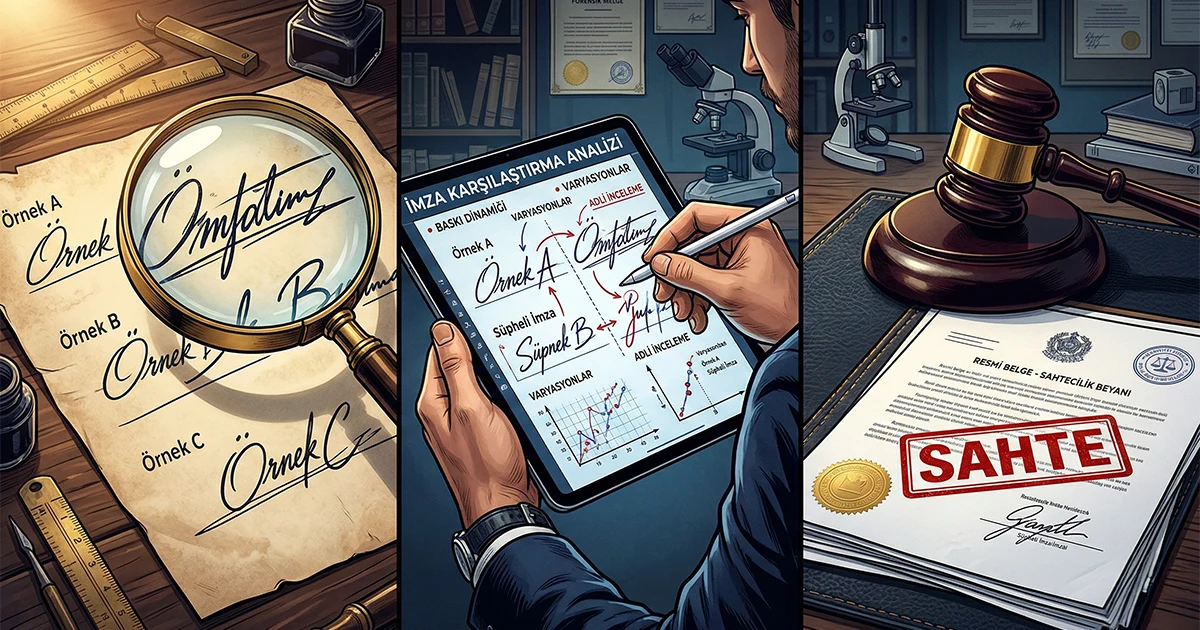
Under the Turkish Criminal Code (TCK), using a forged signature constitutes the offence of forgery of an official document (TCK Art. 204) or forgery of a private document (TCK Art. 207). Heavy prison sentences are prescribed for these offences. Scientific analyses carried out at the Rota Kriminal laboratory help bring the truth to light and prevent loss of rights. Seek expert support without delay.
1️⃣ Is There a Penalty for Forging a Signature? Which Offences Does It Cover?
Yes, forging a signature carries very clear and severe sanctions under the Turkish Criminal Code (TCK). Depending on the type of document and how the act was committed, the use of a forged signature falls into two main categories of offence:
- Forgery of a Private Document: Covers forgery committed on documents such as contracts, lease agreements or ordinary promissory notes (senet) between private individuals.
- Forgery of an Official Document: Forgery committed on documents that are valid before the state, such as notarised documents, court decisions, land registry records or negotiable instruments (cheques, promissory notes); the penalty is considerably heavier.
The penalties are determined by the court according to the nature of the forged document, whether the act was organised and the extent of the harm caused, and can amount to many years of imprisonment.
2️⃣ The Signature Challenge Process: How Is a Signature Denial Proven?
If a person claims that the signature on a document presented to them is definitely not theirs (signature denial), they should take the following legal steps:
- Legal Objection: A formal objection must be filed without delay with the relevant court or enforcement office (icra dairesi, the office handling debt enforcement proceedings).
- Taking Reference (Comparison) Signatures: Current signature and handwriting samples are taken from the objecting person in the presence of the court, both standing and seated and with different pens. In addition, the person’s genuine signatures from previous years held by official institutions (banks, notaries, civil registry offices, etc.) are requested.
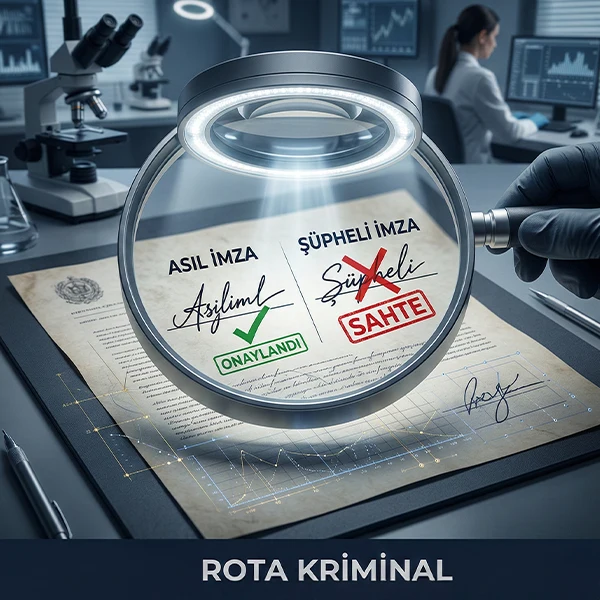
- Forensic Signature and Handwriting Examination: All the collected material, together with the original of the disputed document, is sent to qualified forensic document examiners or forensic laboratories.
- Expert Opinion (Report): Following the examination, a scientific “Signature Examination Report” prepared using microscopic and optical methods is submitted to the court. In this process, this scientific report is the most conclusive and vital piece of evidence.
Key Information
Signature examinations carried out on photocopies or scanned documents may not always be accepted as conclusive evidence in court. For a fully reliable result, examining the original document bearing the wet ink signature is essential.
3️⃣ Forged Signature Penalties and How to Determine Who a Signature Belongs To
Finding out who a suspicious signature on a document belongs to is not as simple as in detective films; it is subject to strict rules. For this:
- First of all, a formal application to the relevant institutions or courts is required.
- For an examination to be possible, the original document or a copy certified by the public prosecutor’s office or the court is needed (examinations carried out on photocopies may not always give conclusive results).
- It is essential that comparison samples taken from the suspects through the court are added to the case file.
It should be remembered that, under the Turkish Personal Data Protection Law No. 6698 (KVKK) and other legislation, laboratories and institutions do not give out information about third parties’ signatures at random without a personal application or a legal request (a court order).
What Is Required for a Forensic Examination
- The original of the disputed document (bearing the wet ink signature)
- Current signature and handwriting samples of the suspect taken in the presence of the court
- Genuine signature samples from previous years held by official institutions
- A formal court or prosecutor’s decision ordering the examination
4️⃣ What Is Compensation for Signature Denial and How Much Is It?
Forged signature penalty. In Turkish enforcement and bankruptcy law, deterrent sanctions apply where a signature is challenged in bad faith in order to prolong proceedings or evade a debt. If a person denies a signature but the forensic examination shows that the signature is in fact their own, they must pay compensation for having caused loss to the creditor.
This rate is determined according to the conditions for enforcement denial compensation in the case and the judge’s discretion. Typically, heavy compensation of not less than 20% of the claim amount (which could reach up to 40% under former legislation or in special circumstances) may be awarded, together with an additional fine.
A forged signature is not only a matter of technical analysis. It is also a serious situation with legal and criminal consequences that can ruin people’s lives. The process must not be left to chance and must be conducted using scientific methods.
5️⃣ What Happens If the Signature Is Confirmed as Forged?
If a forensic examination by independent experts scientifically proves that the signature is forged:
- The document concerned (contract, promissory note, etc.) is legally deemed null and void.
- A criminal investigation (by the Chief Public Prosecutor’s Office) is opened against those who committed the forgery or knowingly used the forged document.
- The injured party acquires the right to bring a claim for pecuniary and non-pecuniary damages against the perpetrators to recover the losses suffered.
In summary: A forged signature or signature denial is not something that can be resolved on the basis of hearsay or simple observation. Where financial losses and prison sentences are at stake, it is vital that these serious proceedings are conducted with the support of experienced lawyers and professional forensic document examiners.
Do You Have Doubts About Your Signature?
Do not lose time if you want to avoid losing your rights and to manage the legal process with the support of a specialist laboratory. Let us review your case now.
Start a Free Preliminary ReviewFrequently Asked Questions
What is the penalty for forging a signature?
Depending on the nature of the document, a forged signature constitutes the offence of Forgery of a Private Document or Forgery of an Official Document. Under the Turkish Criminal Code, forgery of an official document carries considerably heavier prison sentences and can lead to imprisonment lasting many years.
How is a signature proven to be forged?
In the case of a signature denial, the most important method of proof is scientific and technical examination. The reference (comparison) signatures requested by the court and the disputed signature are analysed with microscopic and optical methods in forensic laboratories or by forensic document examiners, and a conclusive report is prepared.
Is there a penalty for a bad-faith signature challenge?
Yes. In Turkish enforcement law, unjustified signature challenges made to prolong proceedings or evade a debt are penalised. If the forensic examination proves that the signature belongs to the person, the debtor may be ordered to pay 'Signature Denial Compensation' of not less than 20% of the claim amount, plus additional fines.
Does Rota Kriminal carry out forged signature examinations?
Yes. The Rota Kriminal Forensic Document Examination Laboratory, with its expert team and modern technical equipment, carries out professional examinations of forged signatures, handwriting, seals and document forgery, and prepares expert opinions that can serve as evidence in court.