
A parent or relative has died, a Turkish court has opened their will, and the copy you received does not look like something they wrote. Perhaps the apartment in Antalya or the family house in Anatolia goes to someone you did not expect. Perhaps the signature is simply wrong. A forged will in Turkey is decided by a court, on the basis of a handwriting examination and a lawsuit filed within strict deadlines. Below we explain which kind of Turkish will is open to forgery, what an examiner looks at, where the original is kept and which deadlines apply under Turkish law.
At a glance
- Turkish succession law applies to real estate in Turkey, whatever the nationality of the deceased (Art. 20/1 Turkish Private International Law Act, MÖHUK).
- A holographic will must be written from start to finish in the testator’s own hand, dated and signed (Art. 538 Turkish Civil Code, TMK). The whole text can therefore be examined, not only the signature.
- Every will found after a death must be handed to the civil court of peace and is opened within one month (TMK 595, 596). The original stays in the court file.
- An action for annulment must be filed within one year of learning of the will and the ground for annulment (TMK 559).
- Statutory provisions as in force on 20 October 2026.
Which Turkish law governs a will that involves property in Turkey?
For land and buildings in Turkey, Turkish law. Article 20 of the Turkish Private International Law Act subjects succession to the national law of the deceased but applies Turkish law to immovable property located in Turkey3. Between Germany and Turkey the 1929 Consular Agreement and its annexed Succession Agreement lead to the same split for immovables: they follow the law of the country where they are located4.
A will made abroad is not invalid just because it does not follow Turkish formalities. Under Art. 20/4 MÖHUK it is valid in form if it complies with the law of the place where it was made, the law governing the succession or the national law of the testator. Whether the testator actually wrote and signed it is a separate question, and that is the one a forensic document examiner answers.
Which type of Turkish will is most exposed to forgery?
The holographic will. The Turkish Civil Code recognises three forms: the official will, the holographic will and, in emergencies, the oral will1. An official will is drawn up by a notary, a civil judge of peace or another authorised official together with two witnesses, and the official keeps the original (TMK 532-537). Disputes over official wills tend to concern whether the testator was really present and whether the signature is theirs.
No official and no witness takes part in a holographic will. Anyone with paper and a pen can produce something that looks like one, which is why most forgery allegations concern this form. If only the signature on an official will is disputed, the method is the comparative analysis described on our signature examination page.
Is only the signature examined on a holographic will?
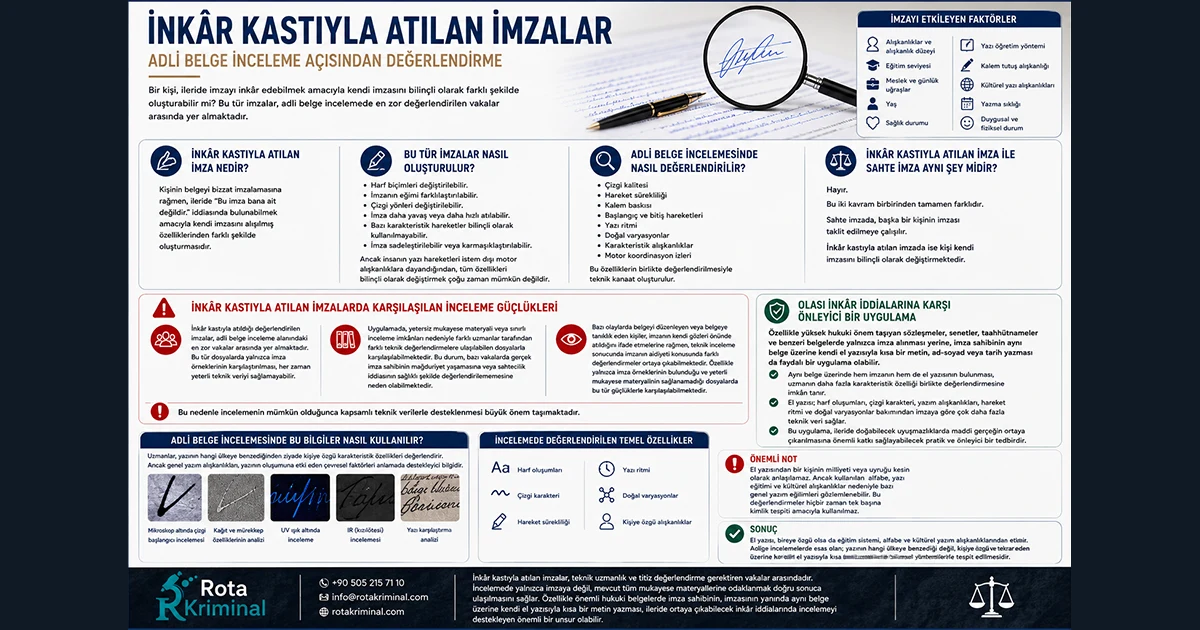
No. Turkish law requires the holographic will to be written from beginning to end in the testator’s handwriting, with the year, month and day, and signed1. If a single line came from someone else’s hand, the formal requirement is not met. For the examiner this is an advantage: instead of one short signature there is a page or more of handwriting, and letter forms, connections, line layout, spacing and the way numbers are written can all be compared. See our handwriting examination page for the method.
When additions or erasures are suspected, a document alteration examination is added. A precise date on which the ink was put on paper cannot be determined; the questions an examination can answer are who wrote the will and whether it was changed afterwards.
Can the tremor of old age be mistaken for forgery?
Yes, and this is the most delicate point in will cases. Wills are often written in the last years of life. Age, illnesses such as Parkinson’s disease and medication can make handwriting shaky, slow and irregular. A forger’s writing is slow and shaky too. What separates the two is how the tremor is distributed across the writing and whether it matches the testator’s other writing from the same period.
Comparing a confident signature from ten years earlier with writing from the final year gives misleading results. Documents from around the date of the will matter most: hospital consent forms, bank and pension papers, notarial deeds, letters or notebooks. Our article on reference samples in handwriting comparison explains which material works best.
Where is the original will and how is it examined?
In the court file. Under TMK 595 any will found after the testator’s death must be handed to the civil judge of peace immediately, whether or not it is valid. The judge opens it within one month, reads it to those concerned and serves each beneficiary with a certified copy of the parts that concern them (TMK 596, 597)1.
A preliminary assessment can be made from the certified copy you received; the general structure of the writing and obvious signs of simulation are visible on a copy. Pen pressure, line quality, ink and the paper surface can only be examined on the original. A firm conclusion therefore requires examining the original will where the file is held, with the court’s permission. How Turkish courts treat a privately commissioned report is covered in private forensic document reports in court.
What are the deadlines for challenging a forged will in Turkey?
There are two, and both are short. If the will appoints an heir or a legatee, you can object within one month of being notified; without an objection the civil court of peace issues that person a certificate of inheritance (TMK 598/2). The certificate does not take away your right to sue for annulment.
A disposition made without the form prescribed by law is a ground for annulment (TMK 557/4), and a holographic will not written or signed by the testator does not meet the form of TMK 538. Article 559/1 sets the time limit: the right to sue lapses one year after the claimant learns of the disposition, the ground for annulment and their own entitlement, and in any case ten years after a will is opened against defendants in good faith, twenty years against defendants in bad faith.
One year passes quickly once you count the time needed to instruct a Turkish lawyer, collect reference writing from abroad and gain access to the original. Decide with your lawyer which action to bring and before which court; an expert opinion gives that decision its technical basis.
Forging a will is also a criminal offence. The Turkish Penal Code treats a will as equivalent to an official document (Art. 210/1), so forgery is punished under Art. 204/1 with two to five years’ imprisonment2. More on criminal liability in the penalty for a forged signature in Turkey.
Do I need to travel to Turkey for the examination?
No. Scans of the certified copy and of the reference writing can be sent by email, meetings take place online and the report can be prepared in English, German or Turkish. Only the examination of the original takes place in Turkey, where the court file is held. Details are on our document examination from abroad page.
This article is for general information only and is not legal advice. Statutory provisions are stated as in the Turkish Civil Code, the Turkish Penal Code and the Turkish Private International Law Act in force on 20 October 2026.
Did they really write this will?
Send us the certified copy and handwriting or signatures of the deceased from the same period. We report a preliminary analysis within 24 hours and, if requested, a detailed report within 48 hours.
Handwriting examination Get an expert opinion +90 505 215 71 10
Istanbul · Ankara · Adana
Sources
- Turkish Civil Code No. 4721, Arts. 531-538, 557, 559, 595-598. mevzuat.gov.tr
- Turkish Penal Code No. 5237, Arts. 204, 210. mevzuat.gov.tr
- Turkish Private International Law Act No. 5718, Arts. 7, 20. mevzuat.gov.tr
- German-Turkish Succession Agreement, annex to Art. 20 of the Consular Agreement of 28 May 1929, § 14; see German Federal Court of Justice (BGH), decision of 12 September 2012, IV ZB 12/12.
Frequently Asked Questions
How long do I have to challenge a forged will in Turkey?
An objection to the certificate issued to an appointed heir must be made within one month of notification (TMK 598/2). An action for annulment must be filed within one year of learning of the will and the ground for annulment (TMK 559). Discuss the right procedure with a Turkish lawyer.
Does Turkish law apply if the deceased was not Turkish?
For real estate located in Turkey, yes. Article 20/1 of the Turkish Private International Law Act applies Turkish law to immovable property in Turkey, whatever the nationality of the deceased.
Can a will be examined from a copy?
A preliminary assessment is possible from the certified copy served by the court. Pen pressure, line quality and ink can only be examined on the original, so a firm conclusion is reached on the original will in the court file.
Do I have to come to Turkey?
No. Scans can be sent by email, meetings take place online and the report can be prepared in English, German or Turkish. Only the examination of the original takes place in Turkey.