A Turkish supplier sends back the contract with a company stamp at the bottom and no signature. Or a document from a Turkish authority carries a seal that does not look like the one you saw last time. Turkish business practice uses two words, kaşe and mühür, that both translate as “stamp” or “seal”, yet the law gives them different roles and different penalties for forgery. Below we explain what a company stamp in Turkey actually proves, when a seal can replace a signature and how an examiner tells a genuine impression from a forged one.
At a glance
- A kaşe is a rubber or polymer stamp that prints a person’s or company’s name, trade name, address and tax details. On its own it does not replace a signature.
- Mühür appears in Turkish law in three senses: the official seal of a public body, a seal placed to close premises or secure property, and an approved seal used by a person who cannot sign.
- A signature must be handwritten (Art. 15 Turkish Code of Obligations, TBK). Only someone unable to sign may use a duly approved seal instead (TBK 16).
- Authorised signatories of a joint stock company sign under the company’s trade name (Art. 372 Turkish Commercial Code, TTK). In practice the trade name is usually stamped.
- Statutory provisions as in force on 21 October 2026.
What is the difference between a kaşe and a mühür in Turkey?
A kaşe identifies; a mühür usually certifies or closes. The kaşe is the everyday business stamp in Turkey. Shopkeepers, companies, doctors and freelancers use it to print their name or trade name, address, tax office and tax number on invoices, delivery notes and contracts. It tells the reader whose document this is. It does not show that anyone agreed to anything.
The legal meaning of mühür depends on context. The Penal Code speaks of the “certifying or documenting seal” of public bodies and of professional organisations with public-law status. A seal placed on a shop door or on confiscated goods is something else again. And the Code of Obligations lists the mühür among the marks a person who cannot write may use in place of a signature.
Is a stamped but unsigned contract binding in Turkey?
Where written form is required, as a rule no. Under the Turkish Code of Obligations, a contract that must be in writing has to bear the signature of the party taking on the obligation, and the signature must be handwritten1. A signature made by other means is sufficient only where custom accepts it, in particular for securities issued in large numbers. A stamp does not fill this gap: it shows on whose behalf the document was issued, not who committed to it.
The same applies to companies. Article 372 of the Turkish Commercial Code requires the persons authorised to sign for a joint stock company to sign under the company’s trade name2. The law does not mention a stamp; it asks for the trade name together with the signature, and in practice this is done by stamping the trade name and signing over it. Whether the signature next to the stamp really belongs to an authorised signatory is a separate question, answered by a signature examination. Why a handwritten signature still matters is covered in what is a wet ink signature.
For foreign businesses, the practical step is to check who may sign. Turkish companies routinely provide an imza sirküleri, a notarised signature circular showing who is authorised to sign for the company and whether alone or jointly. Ask for it before a significant contract and compare the signature on your contract with the one in the circular.
When can a seal replace a signature under Turkish law?
Only for a person who cannot sign. Article 16 of the Code of Obligations allows those unable to sign to use a fingerprint, a hand-made mark or a seal instead of a signature, provided it has been duly approved; the rules on bills of exchange, cheques and promissory notes remain reserved1. The provision is meant for people who cannot read or write or cannot use their hands. A person who can sign does not create a valid signature by pressing a seal.
Is forging a stamp punished the same way as forging a seal?
No. Producing or using a forged certifying or documenting seal of a public body or of a professional organisation with public-law status is punishable under Article 202/2 of the Turkish Penal Code with one to six years’ imprisonment; for the seals of the Presidency and the Speaker of Parliament the range is two to eight years3. Because producing the seal is itself an offence, the penalty applies even if the seal has never been used on a document.
Where a forged stamp or seal is used on a document, the document forgery provisions apply: two to five years for an official document (Art. 204/1) and one to three years for a private document (Art. 207/1). Removing a seal placed by court or administrative order is a different offence, breaking of seals, under Article 203. For an overview of forgery types see our guide to document forgery and alteration.
How is a forged stamp impression detected?
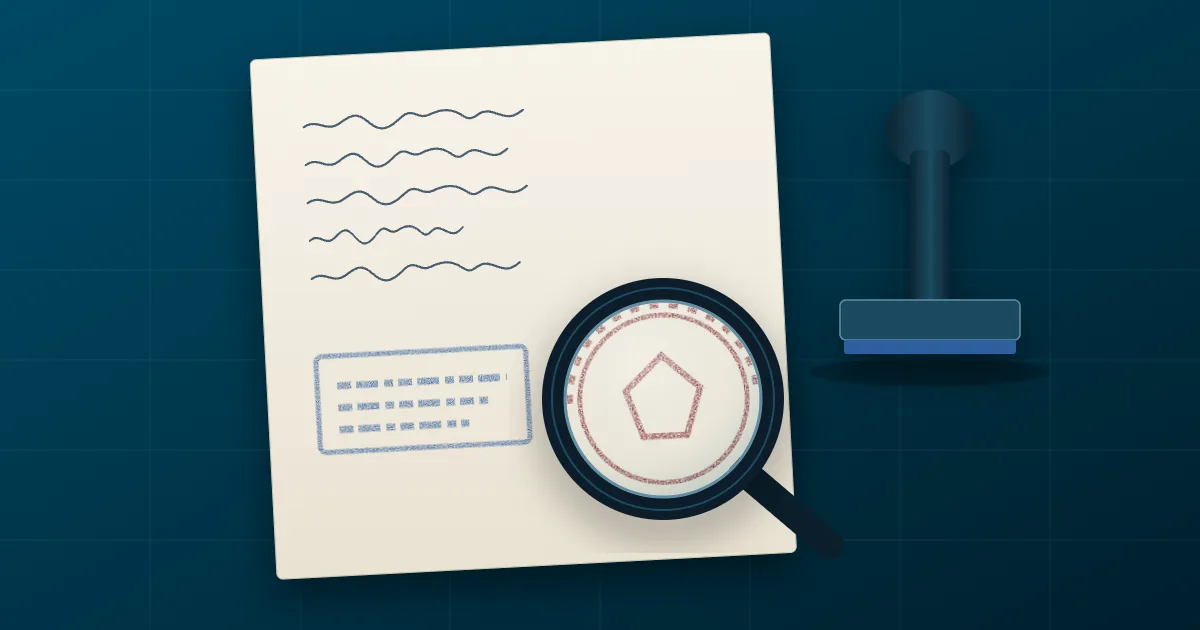
By comparing the questioned impression with impressions known to come from the genuine stamp. Every stamp picks up its own wear, nicks and dirt over time. Impressions from the genuine stamp show these defects in the same places; a stamp remade with the same text does not, even if the lettering looks identical. Typical findings:
- Remade stamp. A stamp produced from a photo of a genuine impression shows small differences in letter thickness, border line and spacing.
- Printed stamp. Toner or inkjet dots instead of wet ink, with no ink spread or edge pooling. This is the field of printed document examination.
- Digitally copied impression. A stamp pasted in on a computer looks pixel-identical on several documents; two wet impressions are never exactly the same.
- Stamp from the wrong period. If the company changed its address or trade name, a new stamp on an older document stands out.
A reliable comparison needs impressions from the same period that certainly come from the same stamp, such as invoices, delivery notes or letters filed with public authorities. Our article on reference samples explains why comparison material decides so much. The methods themselves are described on our stamp and seal examination page.
This article is for general information only and is not legal advice. Statutory provisions are stated as in the Turkish Code of Obligations, the Turkish Commercial Code and the Turkish Penal Code in force on 21 October 2026.
Is the stamp on your document genuine?
Send us a scan of the questioned document and genuine impressions from the same period. We report a preliminary analysis within 24 hours and, if requested, a detailed report within 48 hours, in English, German or Turkish.
Stamp and seal examination Get an expert opinion +90 505 215 71 10
Istanbul · Ankara · Adana
Sources
- Turkish Code of Obligations No. 6098, Arts. 14, 15, 16. mevzuat.gov.tr
- Turkish Commercial Code No. 6102, Art. 372. mevzuat.gov.tr
- Turkish Penal Code No. 5237, Arts. 202, 203, 204, 207. mevzuat.gov.tr
Frequently Asked Questions
Does a company stamp replace a signature in Turkey?
No. Where written form is required, the party taking on the obligation must sign by hand (TBK 14, 15). A company stamp shows on whose behalf a document was issued, not who committed to it.
How do I check who may sign for a Turkish company?
Ask for the company's imza sirküleri, a notarised signature circular that shows who is authorised to sign and whether alone or jointly, and compare it with the signature on your contract.