Document Forgery and Alteration: A Complete Guide
Document forgery and alteration are among the most frequently encountered offences in the Turkish legal system, and among those with the most serious consequences. Changing the figure on a promissory note (senet), adding a line to a contract afterwards, tampering with the date on a rental agreement or drawing up an entirely fake document – each of these is a distinct form of forgery subject to different technical and legal processes. In this guide we cover every aspect of what document forgery and alteration are, their types, how they are detected in a laboratory setting, and the sanctions under the Turkish Criminal Code (TCK).
Forgery is as old as human history; we looked at striking examples from antiquity to the present day in our article on the history of document forgery. In the modern world, the scientific answer to this offence is the discipline of forensic document examination: by analysing a document’s paper, ink, writing and printing with technical equipment, it establishes with scientific certainty whether the document has been tampered with.
The Difference Between Document Forgery and Alteration, and Types of Alteration
Although document forgery and alteration are often used interchangeably, they are technically different concepts. Forgery means producing a document that is false from beginning to end; drawing up a fake promissory note or creating a contract that never existed falls into this category. Alteration (tampering), on the other hand, is the subsequent modification of a document that came into existence as genuine and valid. In other words, with alteration there is a document that was once legally genuine, and the offender interferes with its content. This distinction directly affects both the method of laboratory examination and the legal classification in court.
The alteration methods we encounter most often in practice are erasure, scraping, addition and obliteration. Each technique – chemical erasure, mechanical scraping, changing existing figures or letters by writing over them, or adding text between lines and in blank spaces afterwards – leaves its own characteristic traces on the document. We explained how these traces are revealed, with case examples, in our article on examining documents for alteration. A particularly striking method is turning a sheet of paper issued for another purpose into a negotiable instrument afterwards; converting a document drawn up for a different purpose into a promissory note by alteration is one of the most dangerous examples of this kind of forgery.
Information Box
The 6 Main Methods of Document Alteration
🧪 Chemical Erasure
Removing writing with solvent chemicals. Leaves traces in the paper texture and in its fluorescent response.
🔪 Mechanical Scraping
Scraping writing off with a razor blade, sandpaper or similar. The thinning of paper fibres becomes visible under oblique light.
✍️ Addition (Insertion)
Adding figures, zeros or lines to blank spaces afterwards. Detected through differences in ink and writing characteristics.
🖊️ Overwriting
Turning an existing figure or letter into another character (1→4, 3→8). The double stroke is visible under the microscope.
⬛ Obliteration / Covering
Scribbling over writing or covering it with correction fluid. The underlying writing can be read under IR light.
📄 Page / Section Substitution
Replacing an intermediate page in a multi-page contract. Revealed by analysing differences in paper, printer and toner.
Alteration of Cheques, Promissory Notes and Contracts: The Highest-Risk Area
Negotiable instruments are where alteration has the most devastating consequences. Adding a single digit in front of the amount on a promissory note can increase the debt tenfold; a small change to the due date can completely alter the limitation period calculation. You can find a detailed technical analysis of tampering with promissory notes through erasure, scraping and addition in our article on alteration of promissory notes and the examination process. If you are faced with an entirely forged bill of exchange or promissory note (kambiyo senedi), a forged promissory note examination scientifically establishes which elements of the instrument are false.
The most effective protection against these risks is the precautions taken when the document is drawn up. We have compiled rules such as writing without leaving blank spaces, stating the amount in both figures and words, and using an indelible pen in our article on points to consider when drawing up a promissory note. A danger often overlooked in everyday life is car rental agreements; signing blank promissory notes in car rental agreements can lead to heavy debts through notes that are filled in later. For a comprehensive analysis of cheques, promissory notes and contracts, see our forensic document examination of promissory notes, cheques and contracts service.
How Is Alteration Detected in the Laboratory?
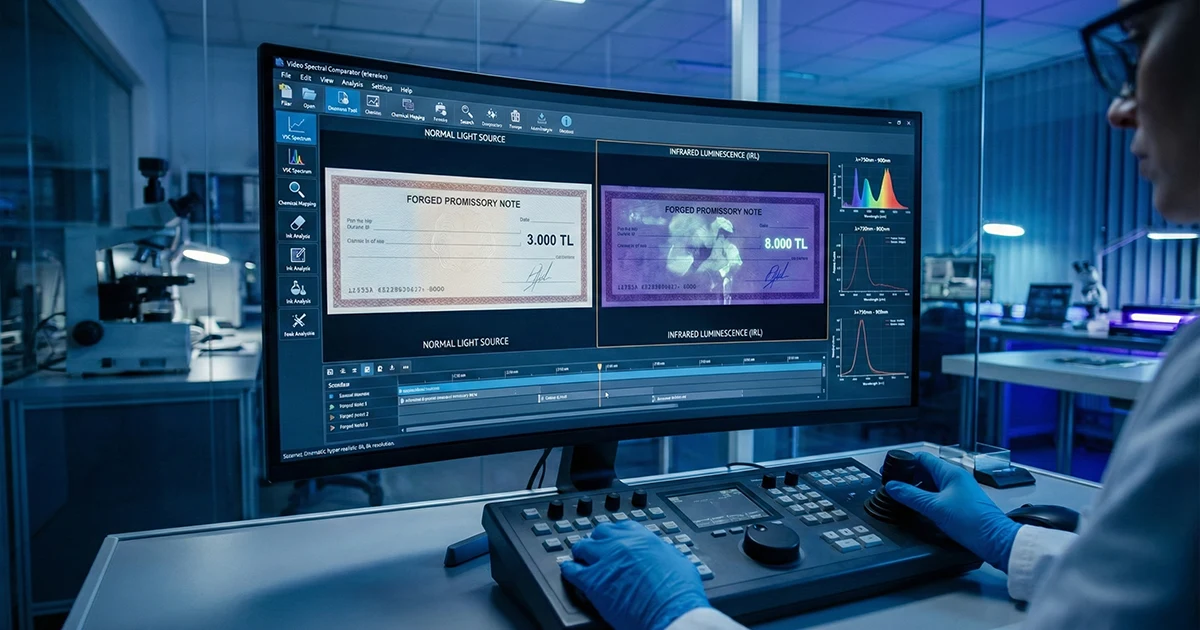
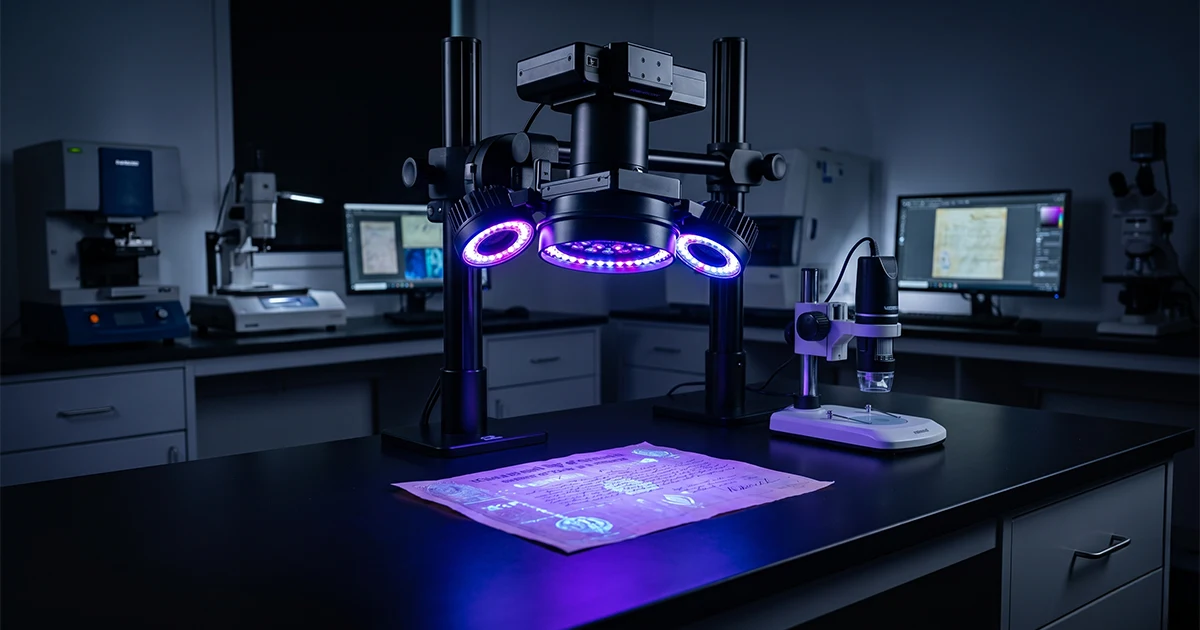
So how is alteration detected in the laboratory? Video spectral comparator (VSC) devices form the backbone of the examination. The document is scanned at different wavelengths under ultraviolet, infrared and oblique light. Two inks that look the same colour can react quite differently under infrared light, making a figure added to a promissory note or a line added to a contract afterwards visible. A stereo microscope reveals scraping in the paper fibres, and an ESDA device reveals indentations transferred to the sheet beneath. We introduced all the technologies used in our laboratory in our article on equipment used in forensic document examination.
The right comparison material is also essential for a reliable result; reference documents are of great importance in forensic examination, so that questioned writing and signatures can be compared with the person’s genuine samples. With computer-generated documents, the examination focuses on the printing technique: forensic examination of laser and inkjet printouts can even determine whether an intermediate page of a multi-page contract came from a different printer. The same methods apply to documents with major consequences from a single signature, such as an eviction undertaking (tahliye taahhütnamesi), a written promise by a tenant to vacate the property on a set date; we shared a striking example in our forged eviction undertaking examination case.
Penalties for Document Forgery and Alteration (TCK 204–211)
Legal Process: Court-Appointed Expert Examination and Private Expert Opinion
In legal proceedings, an allegation of document forgery directly affects civil cases as well as criminal cases; a promissory note proven to have been altered can have consequences extending to the cancellation of enforcement proceedings (icra takibi). At this point, the element that determines the outcome of the case is the expert report. Courts may have the examination carried out by the Council of Forensic Medicine (Adli Tıp Kurumu) or by court-appointed experts, and the parties also have the right to submit an expert opinion; a private expert opinion obtained under CMK 67/6 (Code of Criminal Procedure) and HMK 293 (Code of Civil Procedure) is effective evidence that strengthens the technical discussion in the case file in the party’s favour. The qualifications of the person preparing this report are decisive; we described the training and experience this expertise requires in our article who is a forensic document examiner.
We have gathered signature forgery, the other major area of document forgery, in a separate guide: our guide to detecting forged signatures, their consequences and the legal process covers every aspect of signature examination. For penalties and objection procedures specific to signature forgery, see our article on the penalty for signature forgery and the objection process.
Since 1999, at our laboratories in Istanbul, Ankara and Adana, Rota Kriminal has been examining allegations of forgery and alteration on promissory notes, cheques, contracts, title deeds, wills and all kinds of documents using scientific methods, and preparing expert opinions that can be submitted as evidence in court.
Frequently Asked Questions
What is the difference between document forgery and alteration?
Forgery is the production of a document that is false from beginning to end. Alteration is the subsequent corruption of a document that was drawn up as genuine, by erasure, scraping, addition or modification. Both constitute the offence of document forgery under the Turkish Criminal Code (TCK).
What is the penalty for document alteration in Turkey?
Forgery and alteration of private documents carries imprisonment of 1 to 3 years under TCK 207, and forgery of official documents carries imprisonment of 2 to 5 years under TCK 204. If committed by a public official, the penalty rises to 3–8 years; for documents deemed valid until proven forged, such as cheques and promissory notes, the penalty is increased by half.
How is document alteration detected?
Alteration is revealed through laboratory methods such as examination under ultraviolet and infrared light with video spectral comparator (VSC) devices, paper fibre analysis with a stereo microscope, and detection of indentations with ESDA. Erasures, scraping, additions and ink differences are documented scientifically using these methods.
How is an expert examination carried out for an altered promissory note?
The court may have the examination carried out by the Council of Forensic Medicine (Adli Tıp Kurumu) or by court-appointed experts. In addition, the parties may obtain an expert opinion from an independent forensic document examiner under CMK 67/6 and HMK 293 and submit it to the case file. Rota Kriminal prepares expert opinions that can be submitted as evidence in court.
Why is it dangerous to sign a blank promissory note?
A blank or incompletely filled promissory note can later be filled in with amounts and dates contrary to the agreement. Blank promissory notes signed as a “security deposit” in car rental agreements in particular can create heavy debts. When drawing up a promissory note, all fields should be completed and the amount stated in both figures and words.