
A hearing date has been set in Turkey, or a payment order has arrived from a Turkish enforcement office. You hold a document whose signature is disputed, and two questions come first: how long does a signature examination take, and what does it cost? Neither has a one-line answer, but what decides the answer is clear. Below are the factors that lengthen or shorten the process, the deadline Turkish law gives a court-appointed expert, and the items that make up the fee.
In brief
- In our laboratory, once the documents and comparison signatures are complete, a preliminary analysis is ready within 24 hours and, if requested, a detailed report within 48 hours.
- Missing comparison material delays an examination more than anything else, followed by an original kept at a court, notary or enforcement office.
- A court-appointed expert in Turkey gets at most three months for the report, extendable by three months with a reasoned decision (HMK 274, CMK 66).
- The fee depends on the number of documents and signatures, the type of examination, access to the original and the type of report.
- Statutory deadlines reflect the texts in force on 18 October 2026.
How long does a signature examination take?
In our laboratory we report the result of a preliminary analysis within 24 hours of receiving the documents. If a report is requested, the detailed report is ready within 48 hours. What matters is when the clock starts: it is the moment both the disputed signature and the comparison signatures are in our hands. If only a scan of the disputed document arrives, the examination starts but cannot finish.
The preliminary analysis shows whether the signature carries signs of simulation and decides the next step. The detailed report puts the findings in writing with photographs and states a conclusion; this is what is filed with the court. The stages of an examination are described in the forensic document examination process.
What makes a signature examination take longer?
In most files the time goes into gathering material rather than into the examination itself. These are the usual causes:
- Too few comparison signatures. If there are no signatures made at official institutions close to the date of the disputed document, they have to be found first. Obtaining records from a bank, notary, land registry or tax office can take days.
- The original is held elsewhere. If the promissory note is at the enforcement office, the power of attorney at the notary or the contract in a court file, a firm conclusion requires access to the original. Sometimes that means an on-site examination at that institution, subject to an appointment.
- Many signatures or documents. A single signature and a contract of dozens of pages initialled on every page do not take the same time.
- More than one type of examination. If additions, erasures or ink differences in the text are also in question, an alteration examination is added as a separate stage.
- A vague question. “Is this signature forged?” and “Was this signature made by the defendant, or by someone else imitating it?” are not the same question. The clearer the question, the faster the work.
How long does a court-appointed expert in Turkey take?
The law sets a ceiling, not a fixed period. Under Article 274 of the Code of Civil Procedure (HMK), the time given for an expert report may not exceed three months; at the expert’s request the court may extend it by up to three more months, giving reasons. In cases subject to simplified procedure these periods are two months1.
Criminal proceedings look similar. CMK 66/1 requires the appointment decision to state the deadline, which may not exceed three months depending on the nature of the task and may be extended by at most three months for special reasons2. Before any of this starts, the court has to order the examination, the cost advance has to be paid and the file has to reach the expert.
Your own deadline is often much shorter. In enforcement based on a promissory note, cheque or bill of exchange, you have five days from service of the payment order to object to the signature. Waiting for the court’s expert within those five days is not possible; an expert opinion that strengthens the objection can only be obtained independently and quickly. Details are in not your signature on a Turkish promissory note.
What determines the cost of a signature examination?
The nature of the document and the scope of the work. Instead of a fixed tariff we quote for each file; the quote is built from these items:
Our order of work also affects the cost. We examine first; if the result is in your favour, we move on to the report. If it is not, there is no report stage and no separate cost for one. An e-invoice is issued for all work.
A court-appointed expert is paid under a different system. Article 6 of the Turkish Expert Witness Law provides that the minimum fee tariff for experts is set and updated every year by the Ministry of Justice’s expert witness department3. That fee is paid from the cost advance the party deposits with the court.
What should I prepare to save time?
The most effective way to shorten the process is to have nothing missing when the examination starts. Before contacting us, gather the following:
- A high-resolution colour scan of the front and back of the disputed document.
- Where the original is: with you, at the enforcement office, at a notary or in a court file.
- Your signatures from around the date of the document: ID card, passport, bank records, notarial deeds, official applications.
- Case details if any: the court or enforcement office, the file number and the time you have left.
Variety matters as much as quantity; signatures from different years and different kinds of documents show the natural variation in a person’s signature. Which documents are most useful is explained in reference samples for handwriting comparison.
Is an examination from a copy faster?
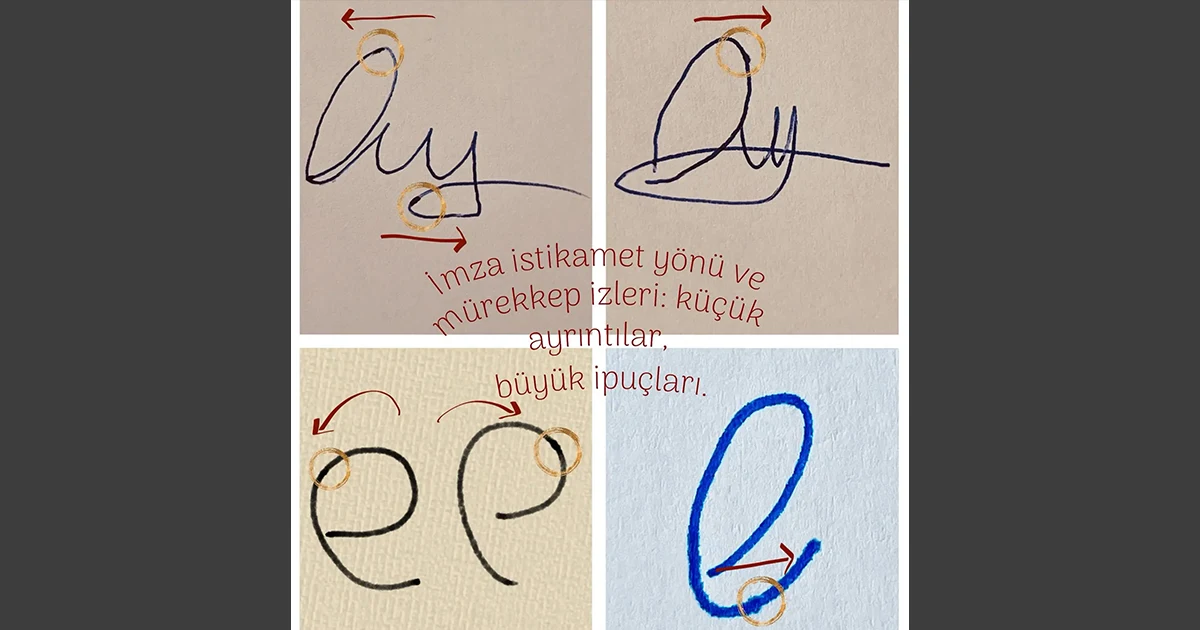
For a preliminary assessment, yes. Without waiting for the original, the general structure of the signature and obvious signs of simulation can be assessed from a clear scan. Pen pressure, line quality, ink and the paper surface can only be examined on the original, so a firm conclusion is reached on the original document.
In practice, working in two stages saves time in most files: a preliminary analysis from the copy sets the direction, and while your lawyer acts on it, access to the original is arranged. How a privately commissioned report is treated by a Turkish court is covered in private forensic document report in court.
Can the examination damage the original document?
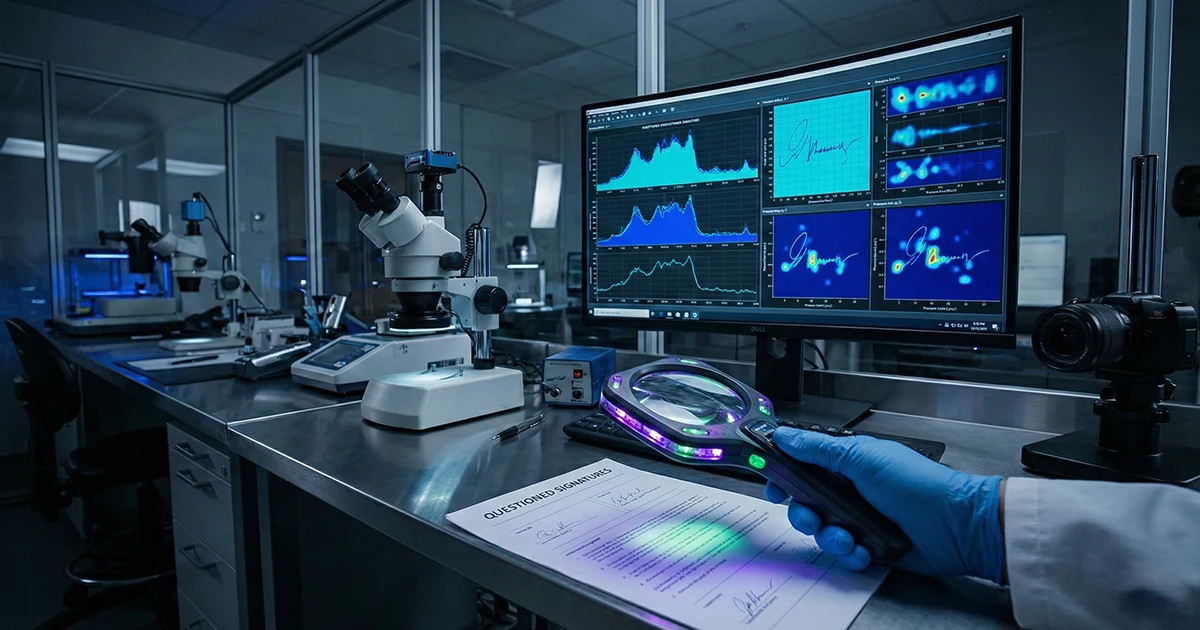
No. The methods we use in signature and alteration examination work without touching the document: magnification under a digital microscope, oblique light to reveal surface and indentation traces, and UV and infrared light to separate ink differences. No sample is taken from the document and no chemicals are applied to it.
This also helps with time. Because the document leaves the examination unchanged, the court or its expert can examine the same document later, and each party can obtain its own expert opinion. Before handing the document over, avoid folding it or writing notes on it; every intervention on the paper makes the examination harder.
This article is for general information and is not legal advice. Statutory deadlines reflect the Turkish Code of Civil Procedure, Code of Criminal Procedure and Expert Witness Law as in force on 18 October 2026.
Running out of time?
Send us a scan of the document and the signature samples you have; we will report a preliminary analysis within 24 hours and, if requested, a detailed report within 48 hours.
Signature examination Request an expert opinion +90 505 215 71 10
Istanbul · Ankara · Adana
Sources
- Turkish Code of Civil Procedure No. 6100 (HMK), Art. 274. mevzuat.gov.tr
- Turkish Code of Criminal Procedure No. 5271 (CMK), Art. 66. mevzuat.gov.tr
- Turkish Expert Witness Law No. 6754 (Bilirkişilik Kanunu), Art. 6. mevzuat.gov.tr
Frequently Asked Questions
How many days does a signature examination take?
In our laboratory, once the documents and comparison signatures have arrived, the preliminary analysis is reported within 24 hours and, if requested, the detailed report is ready within 48 hours. Missing comparison material and access to the original are what usually delay it.
How long does a Turkish court-appointed expert take?
Under HMK 274 the expert gets at most three months, extendable by three months with a reasoned decision; in simplified procedure these periods are two months. In criminal cases CMK 66 sets the same three months plus at most three months.
Is the fee for a signature examination fixed?
No. It depends on the number of documents and signatures, the type of examination, the comparison material, access to the original and the type of report. We examine first and move on to the report only if the result is in your favour.
Can a signature be examined without the original?
A preliminary assessment is possible from a clear scan. Pen pressure, line quality and ink can only be examined on the original, so a firm conclusion is reached on the original document.