
How Is Signature Examination Carried Out?
Signature examination is one of the most frequently requested and most sensitive specialisms in forensic document examination. Questions such as who a signature belongs to, whether it was placed at the same time as the document or later, or whether it has been imitated cannot be answered by looking at superficial similarities alone. Signature examination is therefore a professional process combining scientific methods, technical equipment and expert evaluation. So how is signature examination carried out?
Signature Examination
Using Scientific Methods
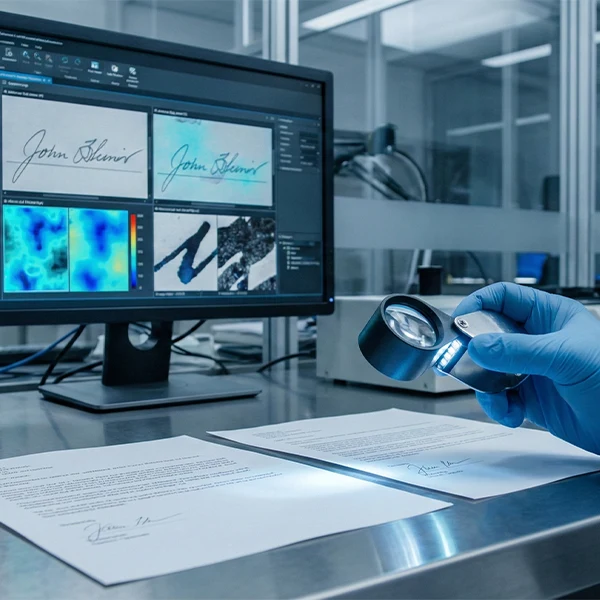
The naked eye can be deceived, but forensic optical instruments never lie. In the Rota Kriminal laboratory, every signature is analysed at micro level and reported.
- Microscopic Stroke Analysis
- Pressure and Slant Assessment
- Full-Spectrum Light Examination
- Expert Report for Use in Legal Proceedings
How Long Does Signature Examination Take?
At the Forensic Medicine Institute, the time taken for signature examination can vary depending on the workload of the forensic units. It is not possible to set a fixed, standard period for every file. The number of documents to be examined, the adequacy of the comparison material and the scope of the file are factors that directly affect the process.
How is signature examination carried out? At Rota Kriminal, in line with our working principles, we conduct signature examinations in defined stages, as follows:
Preliminary Examination
The general condition of the document, the position of the signature and any visible signs of forgery are analysed. A roadmap is set.
Expert Report
Detailed technical analyses are completed, optical instrument data are processed and a report suitable for use in legal proceedings is prepared.
At the preliminary stage, the general condition of the document, the position of the signature, visible signs of forgery and the examination methods to be applied are determined. Detailed comparisons and technical analyses are then completed and the reporting stage begins. How is signature examination carried out?
What Is Looked At in Signature Examination?
How is signature examination carried out? Signature examination is not a superficial assessment based on a single criterion. It is a multi-parameter analysis aimed at revealing how the signature was formed, the nature of the writing movements and the writer’s individual motor habits. The evaluation is therefore made by considering several elements together.
The following parameters are given particular attention during the examination:
Line quality:
The smoothness, continuity and natural flow of the signature strokes are assessed. In genuine signatures the strokes are usually uninterrupted and confident. In imitated signatures, irregularity, breaks or artificiality may be observed in the strokes.
Speed and fluency of movement:
Genuine signatures contain automatic, rhythmic motor movements based on the writer’s muscle memory. In imitated signatures, because the signature is consciously controlled, hesitations, slowing down and a loss of fluency are common.
Pressure distribution:
Whether the pressure applied by the pen to the paper is balanced throughout the signature is examined. In natural signatures the pressure distribution is usually consistent. In forged signatures, excessive pressure or loss of pressure may be found in certain areas.
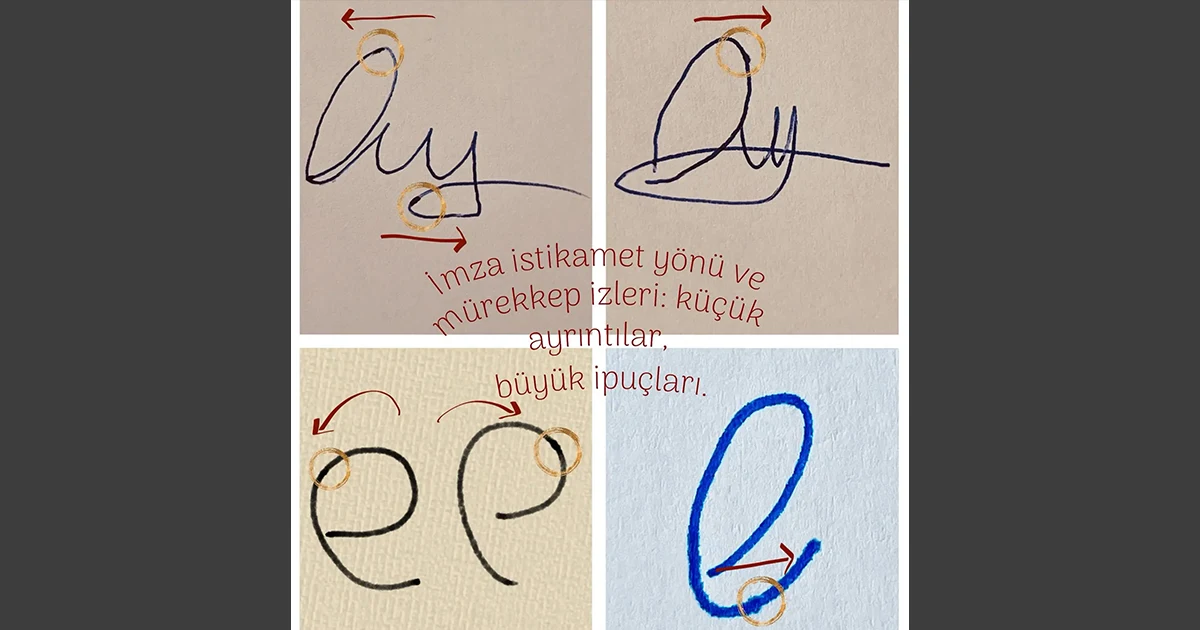
Starting and finishing points:
The point at which the signature begins, how the stroke ends and whether the finishing movements are natural are assessed. Abrupt stops or artificial endings at stroke terminations in particular may be an indication of forgery.
Proportion and placement:
The size of the letters, the spacing between them, the overall form of the signature and its position on the document are examined. In genuine signatures these proportions are usually stable; in imitated signatures, errors of scale and placement may be seen. Let us continue with the question of how signature examination is carried out.
These parameters are evaluated not on a single signature alone but together with reference signatures. In this way, the writer’s individual writing habits, motor behaviour and signature characteristics are established in the light of scientific data. The examination is based on the criteria of consistency, continuity and naturalness rather than a search for similarity.
Optical Methods
How is signature examination carried out? Signature examination is not simply an assessment made with the naked eye. Optical and technical methods are used to increase the reliability of the examination and reveal details that cannot be seen by eye. These methods provide important data on how the signature was produced and ensure that the examination rests on scientific foundations.
The main methods used in this context are:
Magnification systems:
These allow signature strokes to be examined at micro level. Irregularities at stroke edges, hesitations and traces of tremor are evaluated in detail with this method.
Oblique lighting:
This makes indentations and pressure marks on the paper surface visible. The direction and intensity of the pressure applied by the pen to the paper are analysed with this method.
UV and IR light analysis:
These make it possible to distinguish different ink types and layers of writing. Signatures placed on the same document at different times, or writing added later, can be detected with these methods.
Using these techniques, the structure of the signature strokes, pressure marks and ink properties are examined in detail, and the data obtained are used in comparative analyses.
Advanced optical instruments such as the Forenscope Document Examination system play an important role in revealing details on a document that cannot be seen by eye. With these instruments, the layer structure of signature strokes, ink densities and optical differences can be evaluated with high precision.
However, such instruments do not produce a definitive result on their own. Interpreting the data obtained from the instrument correctly requires in-depth knowledge of writing dynamics, ink behaviour and document production processes. Optical examination is therefore a process in which technical data and expert evaluation are considered together.
At Rota Kriminal, signature examinations are conducted within a holistic approach in which findings from optical instruments are integrated with expert opinion and comparative analyses. The aim is not merely to identify similarities but to establish scientifically how the signature was produced.
Where Is Signature Examination Carried Out?
After the question of how signature examination is carried out, the next important question is where it is done. Signature examinations are carried out:
- at the Forensic Medicine Institute (Adli Tıp Kurumu)
- at the Turkish National Police Criminal Laboratories
- in forensic document examination units
- in laboratories authorised under the court-appointed expert (bilirkişi) system.
Whether the person carrying out the examination is trained and experienced as a document examiner is of great importance for the legal weight of the report. Can It Be Determined When a Signature Was Placed? Can Ink Age Analysis Be Carried Out?
One of the most frequently asked questions is whether it can be determined exactly when a signature was placed. Contrary to popular belief, from a scientific point of view:
The exact age of ink cannot be determined scientifically. For this reason, “ink dating analysis” in the classic sense is not a reliable method. The first main reason is that the chemical structure of ink does not change in a linear, predictable way over time. Inks vary greatly according to manufacturer, formulation and the pigments used. Even pens of the same make and model can age differently under different environmental conditions.
Secondly, the drying and ageing of ink are directly affected by environmental factors. Light, temperature, humidity, paper type and storage conditions significantly change the chemical behaviour of ink. It is not possible to determine these variables retrospectively with certainty. In addition, ink manufacturers may change their formulations over time. This reduces the reliability of reference comparisons and makes it difficult to generalise the results obtained. For this reason, findings obtained in a laboratory setting may not always accurately reflect real conditions of use.
For these reasons, there is no scientifically valid, universal method that can determine the exact date or time of ink. Some experimental approaches in the literature can only offer approximate and relative assessments and do not provide precise dating.
However, at Rota Kriminal our experts use case-specific technical approaches to assess:
- whether different inks have been used
- whether there is technical inconsistency between pieces of writing
- traces of later additions or interference
- the characteristic structure of the signature over the years, as part of a holistic examination.
Important Information: The Truth About Ink Age
Scientifically, there is no universal method that can determine the exact date of signing (day/time) of ink. Promises that “ink age can be determined” should be treated with scepticism. At Rota Kriminal we carry out technical inconsistency and layer analyses based on scientific findings, not speculation.
🔍 Leave No Room for Doubt: Find Out the Truth
Signature forgery can be too complex to detect with the naked eye. Do not lose time in proving your case with scientific reports.
START A FREE INITIAL CONSULTATIONFrequently Asked Questions
Can Ink Age Analysis (Signature Dating) Be Carried Out?
Scientifically, there is no universal method that can determine the exact date of signing (day/time) of ink. However, by examining technical inconsistencies, layer analyses and physical findings, scientific findings can be made as to whether a document was edited afterwards.