
1. The Neuromuscular Nature of a Signature and Stroke Direction
A signature is not simply a shape or a set of symbols placed on paper. In forensic document examination literature, a signature is defined as a neuromuscular reflex produced by the coordinated work of the brain, the nervous system and the muscles. When a person signs, hand habits acquired over the years (motor memory) take over and move the pen in a subconscious flow.
Our examinations at Rota Kriminal rest on one fact: a forger can imitate the shape of a signature, but cannot copy the signer’s neurological speed or the rhythm stored in their muscle memory. This article describes in detail the dynamic traces that cannot be seen with the naked eye but are caught “red-handed” under the microscope. These analyses play a critical role, particularly in the examination of wet-ink signatures.
2. The Biomechanics of a Signature and Kinetic Energy
Every signature has its own field of energy. The moment the pen tip touches the paper, the signer’s physical and characteristic features are transferred to the surface through the ink. Two key factors are examined in this process:
- Velocity and Acceleration: A natural signature starts at a certain speed, slows down in the curves and accelerates again at the end. These changes in speed directly affect how the ink is distributed on the paper. In a signature written quickly, the lines are sharper and smoother and the ink layer is thinner.
- Pressure (Fulaj): The vertical force the pen applies to the paper creates pressure traces known in Turkish practice as “fulaj”. In forgery attempts, the imitator concentrates on the shape and therefore moves the pen more slowly and hesitantly, which disrupts the natural pressure map of the signature.
3. Ink Dynamics and Microscopic Findings
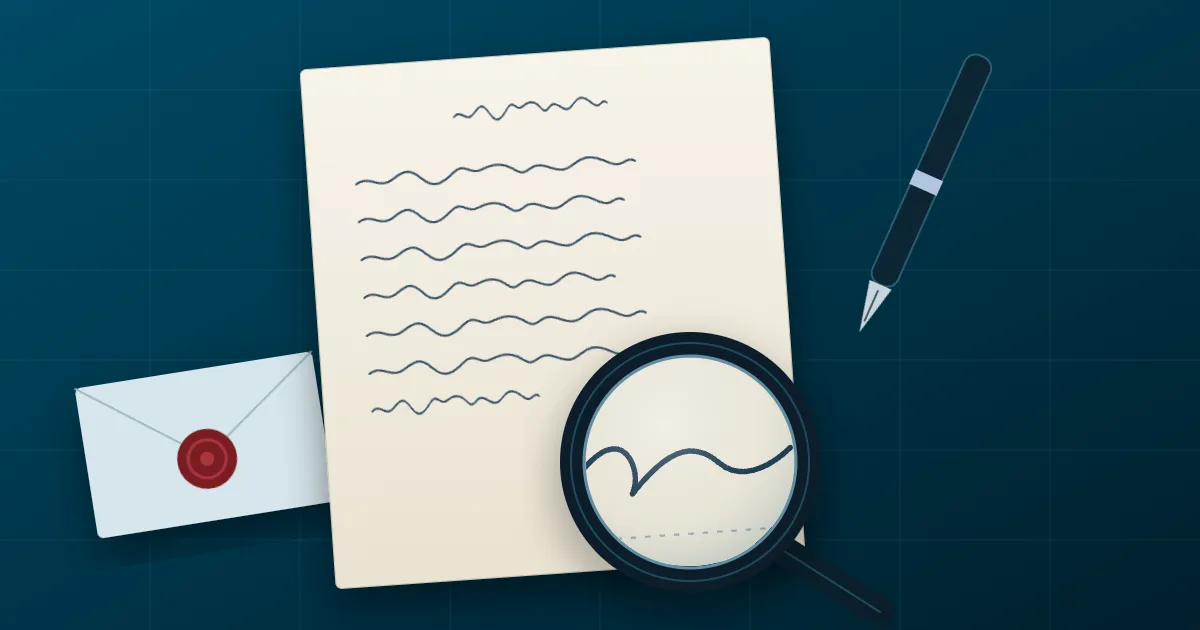
In laboratory examinations, the way the ink interacts with the paper fibres is like the fingerprint of a signature. The “Ink Traces” highlighted in the image are analysed under the following headings:
A. Stroke Direction (Directional Stroke)
The direction in which the pen moved is determined from the points where ink accumulates on the paper surface. With ballpoint pens in particular, the rotation of the ball in the pen tip creates microscopic channels called “striations” along the edges of the line. These channels show conclusively whether the signature was written from left to right or from top to bottom.
B. Ink Accumulations (Gooping/Blobbing)
When the writer makes sudden changes of direction or pauses while signing, extra ink is released from the pen tip. In a natural signature these accumulations occur at specific, consistent corners; in a forged signature, ink pools (blobbing) appear at meaningless points where the imitator “stopped to think about how to match the shape”.
C. Feathered Edges and Viscosity
The fluidity of the ink (its viscosity) is inversely related to signing speed. In slowly written forged signatures, the ink is absorbed by the paper fibres (capillarity), and irregular spreading, which we call “feathering” or “fraying”, forms along the edges of the line. In a fast, natural signature, the edges are razor-sharp.
“A forger can imitate the shape of a signature, but can never copy the signer’s neurological speed or the unique rhythm stored in their muscle memory. A signature is as personal as a fingerprint.”
4. The Anatomy of Forgery: Why Does Imitation Fail?
When a signature is imitated, the forger’s brain struggles with two opposing commands: “Draw something similar” and “Look natural”. This conflict leaves the following pathological findings on the signature:
- Tremor: Microscopic zigzags in the lines caused by a loss of pen control. The forger’s hand trembles especially on long, curved strokes.
- Pen Lifts: The forger lifts the pen from the paper at unnecessary points to check how to complete the rest of the signature. This creates microscopic gaps that break the continuity of the signature.
- Retouching: After finishing the signature, the imitator goes over it again to correct the parts that “don’t look right”. Under the microscope, these double strokes are clearly visible.
5. The Rota Kriminal Laboratory and Technical Equipment
At Rota Kriminal, we use technical equipment that goes beyond classical magnifying-glass examination. The systems we use in signature and handwriting examinations are:
- Video Spectral Comparator (VSC): Examines the reaction of ink under different wavelengths of light (UV, IR) and distinguishes between different pens that appear to be the same colour.
- Stereo Microscopes: Allow us to examine the three-dimensional topography of the signature (the depth of pressure).
- High-Resolution Imaging: Captures burrs and directional traces invisible to the eye in 4K resolution in digital form.
6. Conclusion
Every signature is its owner’s biometric data. Behind a signature lies not just a name, but the person’s state of mind at that moment, the anatomy of their hand and the unique rhythm of their movement.
The science of forensic document examination does not merely ask “Does it look similar?”. It provides the scientific answer to the question “Was this line produced at this speed, with this pressure and in this direction?”. In the light of this scientific reality, Rota Kriminal is committed to revealing the truth in its purest form.