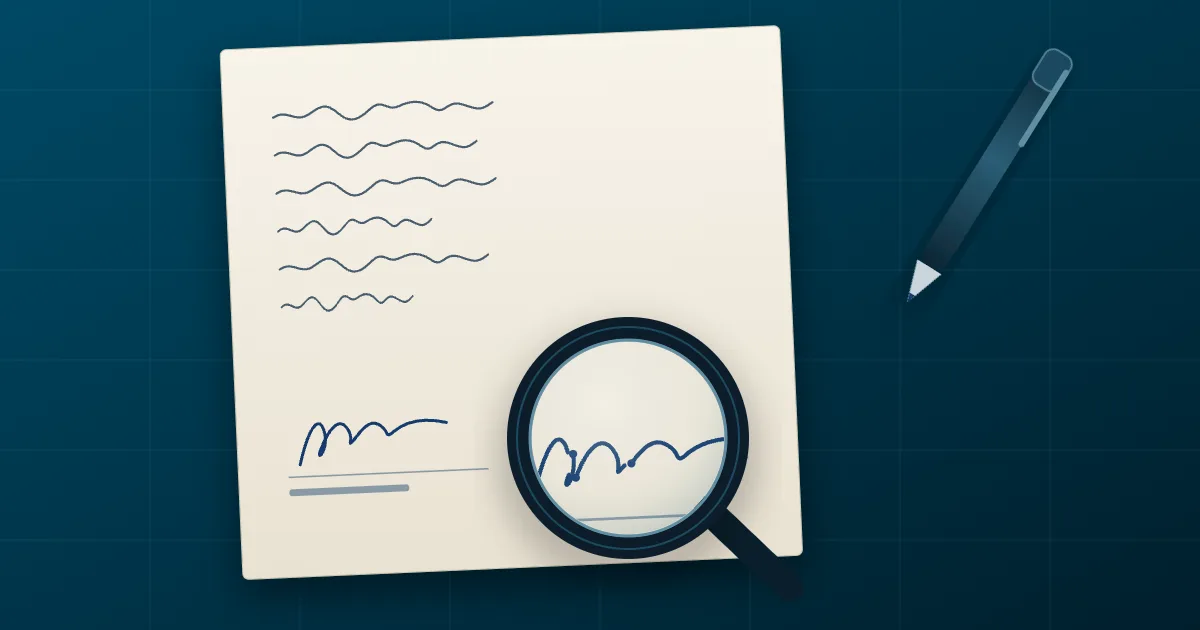

Can a person who genuinely signs a document deliberately depart from their usual signature characteristics so that they can deny the signature later? This question comes up from time to time in forensic document examination practice and is one of the most technically difficult types of case to assess.
Although differences in the appearance of a signature may raise suspicion at first glance, what matters in a scientific examination is not shape similarity alone but a combined assessment of how the signature was produced, the character of its movement and the writer’s individual writing habits.
What Is a Signature Disguised with Intent to Deny?
A signature disguised with intent to deny is one where a person, despite signing the document themselves, deliberately forms their own signature differently from its usual characteristics so that they can later claim “This signature is not mine.”
The aim here is not to imitate another person’s signature, but for the person to alter their own signature so that they can deny it later.
How Are Such Signatures Produced?
In signatures produced with the aim of denial, the person may:
- change letter forms,
- alter the slant of the signature,
- change the stroke directions,
- write the signature more slowly or more quickly than usual,
- deliberately leave out certain characteristic movements,
- simplify the signature excessively or make it more complex.
However, because writing movements rely largely on involuntary motor habits, it is often impossible to change all characteristic features deliberately.
How Is It Assessed in Forensic Document Examination?
Examiners do not decide by looking only at the general appearance of the signature. In the forensic document examination process, the signature is treated as a whole in terms of how it was produced. During the examination,
- line quality,
- continuity of movement,
- pen pressure,
- starting and finishing movements,
- writing rhythm,
- natural variations,
- characteristic habits,
- traces of motor coordination
are assessed together. For this reason, two signatures that look quite different from each other may, technically, bear characteristic features belonging to the same person.
Is a Signature Disguised with Intent to Deny the Same as a Forged Signature?
No. The two concepts are completely different. In a forged signature, someone attempts to imitate another person’s signature. In a signature disguised with intent to deny, the person deliberately alters their own signature.
For this reason, the two situations are assessed according to different technical criteria.
Difficulties in Examining Signatures Disguised with Intent to Deny
Signatures considered to have been disguised with intent to deny are among the most difficult cases in forensic document examination. In such files, comparing signature samples alone may not always provide sufficient technical data.
In practice, there are files in which different experts reach different technical assessments because of insufficient comparison material or limited examination facilities. In some cases this can cause the true signatory to suffer harm, or prevent a forgery allegation from being properly assessed.
In some cases, although the people who drew up or witnessed the document state that the signature was placed before their eyes, the technical examination may produce differing assessments as to the authorship of the signature. Such difficulties arise especially in files where only signature samples are available and adequate comparison material cannot be obtained. It is therefore very important that the examination is supported by comprehensive technical data wherever possible.
A Preventive Practice Against Possible Denial Claims
To prevent signature-denial claims that may arise later, especially in contracts of high legal importance, promissory notes (senet), written undertakings and similar documents, it can be a useful practice to have the signatory also write a short text, their name and surname or the date in their own handwriting on the same document, rather than taking only a signature. (Having the handwritten entries on promissory notes and cheques written by the debtor is particularly useful.)
With this method, if the signature is denied later on, the examiner can technically assess not only the signature but also the handwriting on the same document.
Handwriting contains far more characteristic features than a signature in terms of letter formation, stroke character, writing habits, movement rhythm and natural variations. Handwriting on the same document can therefore provide additional technical data and contribute to a more comprehensive assessment.
Although this practice is not legally required, adding a short piece of handwriting next to the signature, especially in important legal transactions, can be regarded as a practical, preventive measure that may help establish the material truth in the event of future denial claims.
The Importance of Correct Assessment in Signatures Disguised with Intent to Deny
Signatures disguised with intent to deny are among the cases in forensic document examination that require technical expertise and meticulous assessment. In such files it is not correct to reach a conclusion by looking only at the general appearance of the signature. A scientific examination requires the characteristic features of the signature, its movement structure, its natural variations and all available comparison material to be assessed together.
Especially on important legal documents, having the signatory write a short text, their name and surname or the date in their own handwriting next to their signature on the same document (with the entries on promissory notes and cheques written by the debtor) can be an important element supporting the examination in the event of future denial claims. Although not legally required, this practice is a preventive measure that can help the technical assessment rest on stronger data. In this way, a sounder basis for examination can be created, both reducing potential harm and making it easier to establish the material truth.
Frequently Asked Questions
What is the difference between a signature disguised with intent to deny and a forged signature?
In a forged signature, another person’s signature is imitated and the signature does not belong to its purported owner. In a signature disguised with intent to deny, the person deliberately alters their own signature; the signature actually belongs to them. The two situations are therefore assessed according to different technical criteria.
Can a person alter their own signature in order to deny it?
A person can deliberately change the appearance of their signature in aspects such as letter form, slant and writing speed. However, because writing movements rely largely on involuntary motor habits, it is often impossible to change pen pressure, movement rhythm and all individual micro-characteristics.
How is a signature disguised with intent to deny detected?
The examination relies not only on the general appearance of the signature but on numerous criteria such as line quality, continuity of movement, pen pressure, writing rhythm, natural variations and traces of motor coordination. This makes it possible to assess whether two signatures that look different technically belong to the same person.
What precautions can be taken against signature denial?
The most effective precaution is for the signatory to add their name and surname, the date or a short text in their own handwriting next to the signature on important documents. On promissory notes and cheques, having these entries written by the debtor provides additional characteristic data for examination if the signature is denied.