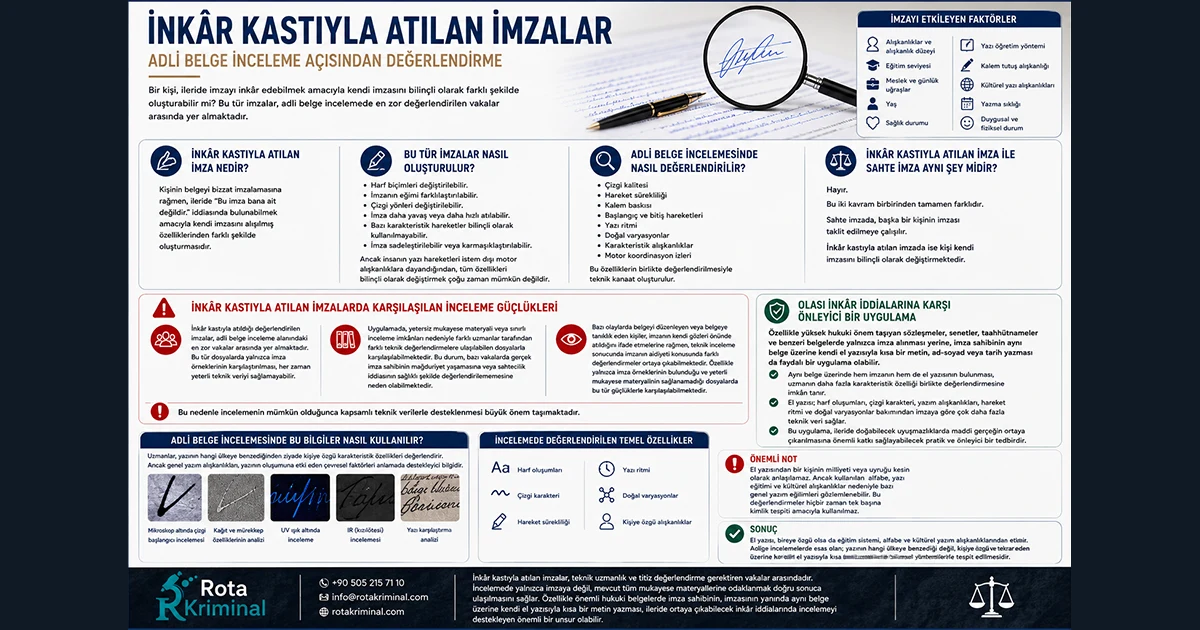
Forensic document examination plays a critical role in solving the document forgery and alteration offences frequently encountered in criminal and civil proceedings. In commercial and legal life, the binding force of promissory notes (senet), cheques and contracts makes it essential to establish the authorship of the signatures on these documents by scientific methods.
A signature is the reflection of neuromuscular (nerve–muscle) coordination on paper and functions like a biometric identity card. However, advancing technology and fraud methods have changed the scale of forgery. Forensic handwriting and document examination reveals the material truth by analysing not only visual similarities but also the pressure, speed, acceleration and calligraphic features of the writing at microscopic level.
Methodological Differences Between Handwriting Personality Analysis and Forensic Document Examination
The concepts of “handwriting personality analysis” and “forensic document examination”, which are often confused by the public, essentially serve different disciplines:
1. Characterological Handwriting Analysis
It aims to analyse the writer’s psychological state, character traits and tendencies. It has no value as material evidence in legal proceedings.
2. Forensic Document Examination
It examines the physical integrity of the document, the authorship of the writing and whether it has been altered. The aim here is to identify the perpetrator. In the Turkish judicial system (in line with the case law of the Turkish Court of Cassation (Yargıtay)), this is the type of examination on which judgments are based.
Scientific Methods Applied in the Laboratory
Forensic document examinations avoid subjective interpretation and rely entirely on data obtained with optical and analytical instruments. The core techniques applied at Rota Kriminal are as follows:
3.1. Comparative Handwriting Analysis
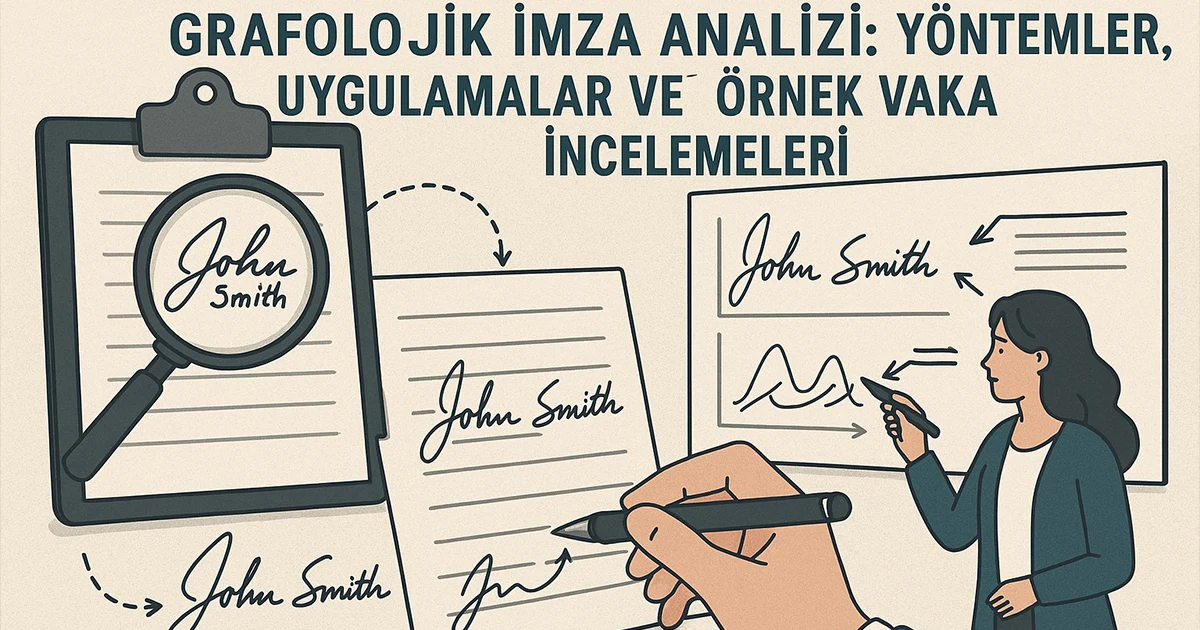
The questioned document is examined side by side with reference (known) documents belonging to the person. This process relies not only on similarity of form but on graphometric measurements such as the start and end points of letters, “hiatus” (pen lift) gaps, baseline alignment and letter axes.
3.2. Pen Pressure and Kinematic Examination
“Depth”, the third dimension of a signature, is the clearest indicator of forgery. In a genuine signature, pressure distribution is natural and variable. In forged signatures, by contrast:
- Lack of Speed: Because simulation requires a conscious thought process, pen speed drops.
- Tremor: Unnatural hand movements cause microscopic breaks in the strokes.
- Hesitation Marks: Ink blobs caused by the pen resting on the paper longer than necessary are detected.
3.3. Video Spectral Comparator (VSC) and Optical Analysis
Details invisible to the human eye are examined under light sources of different wavelengths (UV, IR):
- Detection of Different Inks: Later additions to a promissory note (for example, a changed figure) glow in different colours on the VSC when pens with different chemical properties have been used.
- Erasures and Scraping: Writing removed from the document by mechanical or chemical means is detected through the damage to the paper fibres.
Types of Forgery and Detection Criteria
The most common methods of document forgery and the criteria our examiners use to detect them are listed below:
| Forgery Method | How It Is Done | Forensic Detection Method |
|---|---|---|
| Copying by Sight (Simulation) | The forger places the genuine signature in front of them and tries to imitate it. | Stiffness in the strokes, low speed and unnatural pen stops. |
| Tracing | The outline of the signature is traced using a light box or carbon paper. | Micron-level overlap with the original signature and carbon/pencil residue in the underlying layer. |
| Freehand Simulation | The signature is memorised and reproduced from memory. | Although the overall form is similar, the “idiosyncratic” (personal) details specific to the signatory are missing. |
| Alteration (Addition) | Changing the amount or the due date of a promissory note. | Differences in ink type and chemical composition under spectral (IR) analysis. |
Case Studies and Forensic Findings
Case 1: Forgery of a Will Using the “Tracing” Method
Case Summary: In an inheritance case, it was alleged that the deceased’s handwritten will had been fabricated afterwards.
Forensic Examination: When the document was examined under a stereo microscope and oblique light, faint graphite (pencil) traces were found beneath the signature strokes. Hesitations caused by the effort to follow the underlying draft were detected in the signature lines.
Result: It was reported that the signature had been created by tracing over a previously prepared draft, and the will was annulled.
Case 2: Altered Figures on a Promissory Note (Box Filling)
Case Summary: The debtor stated that a promissory note debt of TRY 10,000 had been put into enforcement proceedings (icra) as TRY 110,000.
Forensic Examination: The ink tone of the figure “1” in the amount box was compared with the other figures using a Video Spectral Comparator. The added figure was found to fluoresce at a different wavelength from the original writing (i.e. it had been written with a different pen).
Result: It was scientifically proven that the promissory note had been altered.
Legal Process: The Evidential Value of a Private Expert Opinion
In legal proceedings, supporting a claim with technical data directly affects the course of the case.
Article 67 of the Code of Criminal Procedure (CMK) and Article 293 of the Code of Civil Procedure (HMK) expressly provide that the parties may obtain a scientific expert opinion from a specialist on technical matters related to the case. The case law of the Turkish Court of Cassation (Yargıtay) holds that courts must assess such reports as “discretionary evidence” and discuss them in the reasoned judgment.
Uncover the Truth in Your Documents
Where a signature is denied or a forged promissory note or alteration is alleged, you can obtain scientific support from our expert team to avoid losing your rights.
Click Here to Request an Expert OpinionReferences and Sources
- Harrison, W.R. (1958). Suspect Documents: Their Scientific Examination. Chicago: Nelson-Hall.
- Osborn, A. S. (1929). Questioned Documents. Boyd Printing Company.
- Precedent decisions of the Criminal General Assembly and Civil Chambers of the Turkish Court of Cassation (Yargıtay).
- Ellen, D., Day, S., & Davies, C. (2018). Scientific Examination of Documents: Methods and Techniques. CRC Press.