Questions such as whether a signature belongs to its purported owner, whether a piece of handwriting was written by a particular person, or whether a document has been altered after the fact cannot be answered by a simple visual assessment. The forensic document examination process is a comprehensive one that brings together scientific methods, technical analysis and expert evaluation. Although every document has its own characteristics, the examination generally consists of a set of defined stages. In this article, we look at the five stages of the forensic document examination process and the scientific methods applied at each stage. For the basic concepts, you may also wish to read our article what is forensic document examination.
1. Receipt of the Document and Preliminary Assessment
The examination process begins when the document, or images of it, reach the examiner. This stage may involve physical delivery of the document, or it may be carried out on the basis of high-resolution scans and photographs sent for a preliminary assessment. In some cases, the examination takes place on site, on original documents held by a court, a courthouse or a public authority. At this stage, the general appearance of the document, the condition of the writing and signatures, possible signs of alteration and the reference material required are assessed. Although a preliminary assessment can be made from a digital image, examining the original document provides a more comprehensive result in cases that require detailed analysis.
2. Collection of Reference Material
In signature and handwriting examinations, sufficient comparison material is needed to reach a correct conclusion. For this reason, samples taken in the presence of the court, signatures from different dates, handwritten documents, official papers, and bank and notarial documents are collected. Genuine (contemporaneous) documents that the person produced naturally in the course of daily life are particularly valuable for the examination. Insufficient material can directly affect the scope of the examination and the strength of the opinion reached; this is why the importance of reference documents in forensic examination is one of the decisive elements of the process.
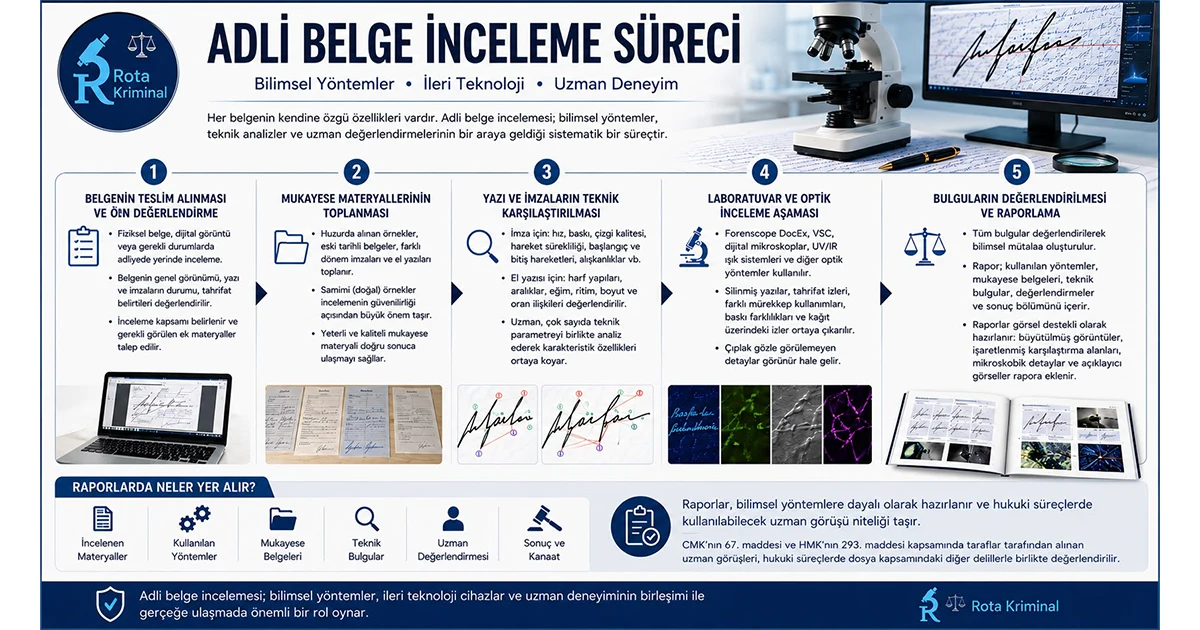
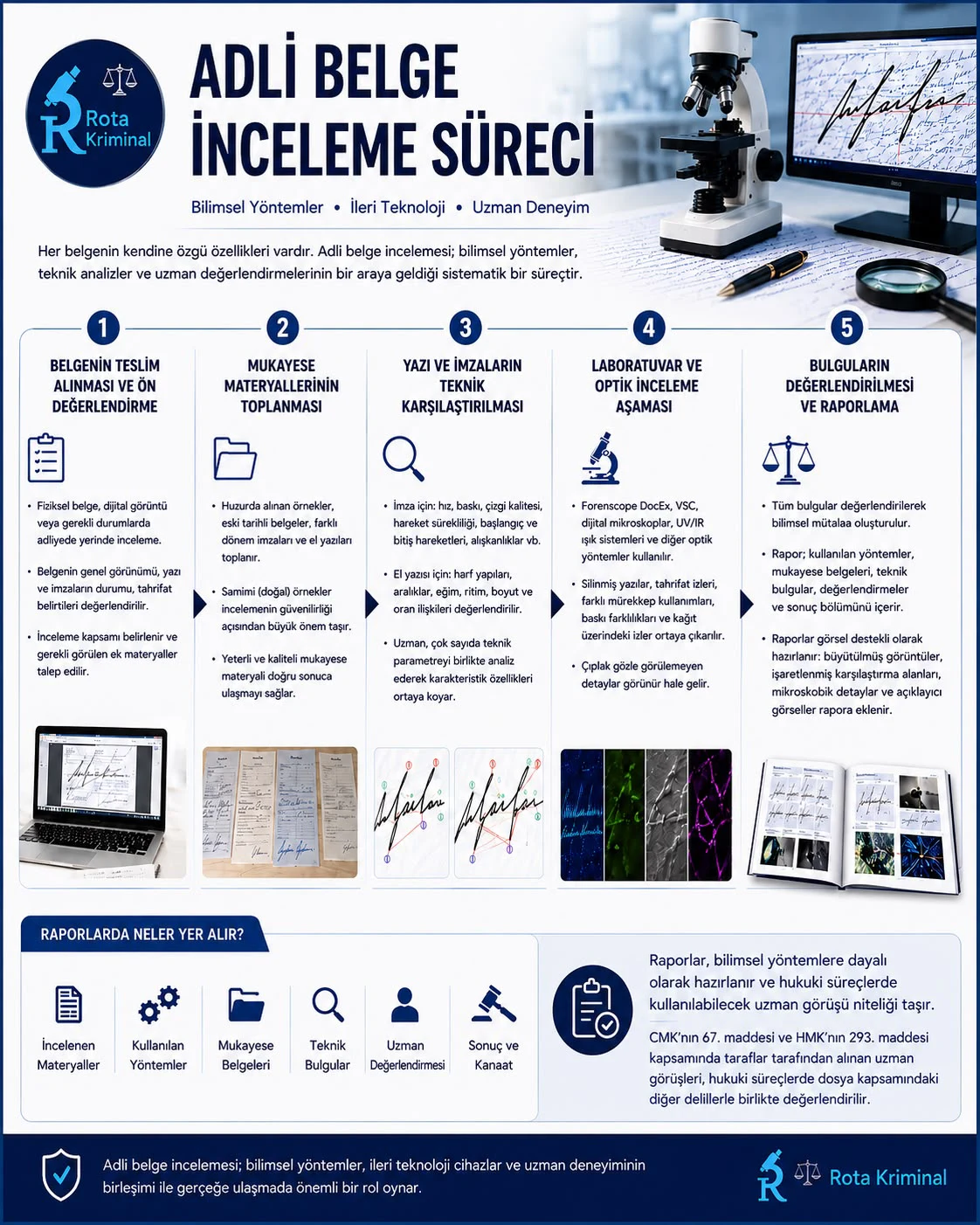
The Forensic Document Examination Process in 5 Stages
The document is received physically or digitally and an initial examination is made.
Sufficient, natural signature and handwriting samples are obtained for comparison.
25–30 technical parameters in the signature and writing are analysed together.
Hidden details are revealed with Forenscope DocEx, VSC and UV/IR.
An expert opinion report is prepared, with the findings supported by images.
3. Technical Comparison of Writing and Signatures
Once the comparison material has been obtained, the examiner begins the detailed analysis. In signature examinations, 25–30 parameters are examined, such as line quality, continuity of movement, pen pressure, starting and finishing strokes, speed, rhythm, characteristic habits and natural variation. In handwriting examinations, letter formations, connections between letters, word and line spacing, slant, writing rhythm, and size and proportion relationships are assessed. Depending on the type of document and the question under examination, the examiner considers a large number of technical parameters together to establish the characteristic features of the writing and signature. This stage is decisive for both signature examination and handwriting examination.
Forensic document examination requires methods consistent with scientific principles such as the internationally recognised SWGDOC forensic document examination standards; this ensures that the findings are reproducible and open to review.4. Laboratory and Optical Examination
In some cases, a comparison of writing and signatures alone may not be enough; it may be necessary to investigate alterations, erasures, additions, differences in printing or the use of different inks on the document. For this purpose, Forenscope DocEx, the VSC (Video Spectral Comparator), digital microscopes, UV light, infrared (IR) examination, oblique lighting and high-resolution imaging systems are used. With these instruments, later additions, erased or concealed writing, traces of alteration, the use of different pens and physical marks on the paper can be revealed in detail invisible to the naked eye. The instruments used in forensic document examination and the methods of alteration examination applied at this stage are of great importance.
“Reaching the correct conclusion depends not on a single feature, but on evaluating 25–30 technical parameters in the signature and writing together using scientific methods.
5. Evaluation of the Findings and Reporting
In the final stage of the examination, all the technical findings obtained are brought together and evaluated. The report sets out the material examined, the examination methods used, the reference documents, the technical findings, the examiner’s evaluation and a conclusion and opinion section. Depending on the subject of the examination, reports are supported by enlarged images, marked comparison areas, microscopic details and visual findings obtained during the technical examination. In signature and handwriting examinations in particular, comparative visual charts are used so that similarities and differences can be shown clearly. In this way, the basis for the conclusions reached in the report is presented in a clearer, more systematic and scientific manner.
Can the Report Be Used in Court?
The report is prepared on the basis of scientific methods and constitutes an expert opinion that can be used in legal proceedings. Expert opinions obtained by the parties under Article 67 of the Code of Criminal Procedure (CMK) No. 5271 and Article 293 of the Code of Civil Procedure (HMK) No. 6100 are assessed together with the other evidence in the case file. You can find more detail on this subject in our article is a private forensic document examination report valid in court, and information on the request process on our expert opinion page.
Conclusion
The forensic document examination process is a comprehensive one that involves far more than comparing a signature or a piece of writing; it is carried out using scientific methods and expert evaluation. Every stage, from receiving the document and collecting reference material to technical comparison and optical examination with advanced instruments, is of great importance in reaching the correct conclusion. A reliable result requires both sufficient comparison material and an examination carried out in accordance with scientific standards.
Frequently Asked Questions
How many stages does the forensic document examination process have?
The forensic document examination process generally consists of five stages: receipt of the document and preliminary assessment, collection of reference material, technical comparison of writing and signatures, laboratory and optical examination, and evaluation of the findings and reporting.
Which parameters are assessed in a signature examination?
In signature examinations, 25–30 technical parameters are assessed together, such as line quality, continuity of movement, pen pressure, starting and finishing strokes, speed, rhythm, characteristic habits and natural variation.
Why is reference material important?
Sufficient, good-quality comparison material is needed to reach a correct conclusion in signature and handwriting examinations. Genuine documents that the person produced naturally are particularly valuable; insufficient material directly affects the strength of the opinion.
Can a forensic document examination be carried out on a digital image?
A preliminary assessment can be made from high-resolution digital images. However, in detailed cases that require examination for alteration or optical examination, examining the original document provides a more comprehensive and reliable result.
Can a forensic document examination report be used in court?
Yes. A report prepared using scientific methods constitutes an expert opinion; it can be obtained by the parties and submitted to the case file under Article 67 of the Code of Criminal Procedure (CMK) and Article 293 of the Code of Civil Procedure (HMK), and is assessed together with the other evidence in the file.