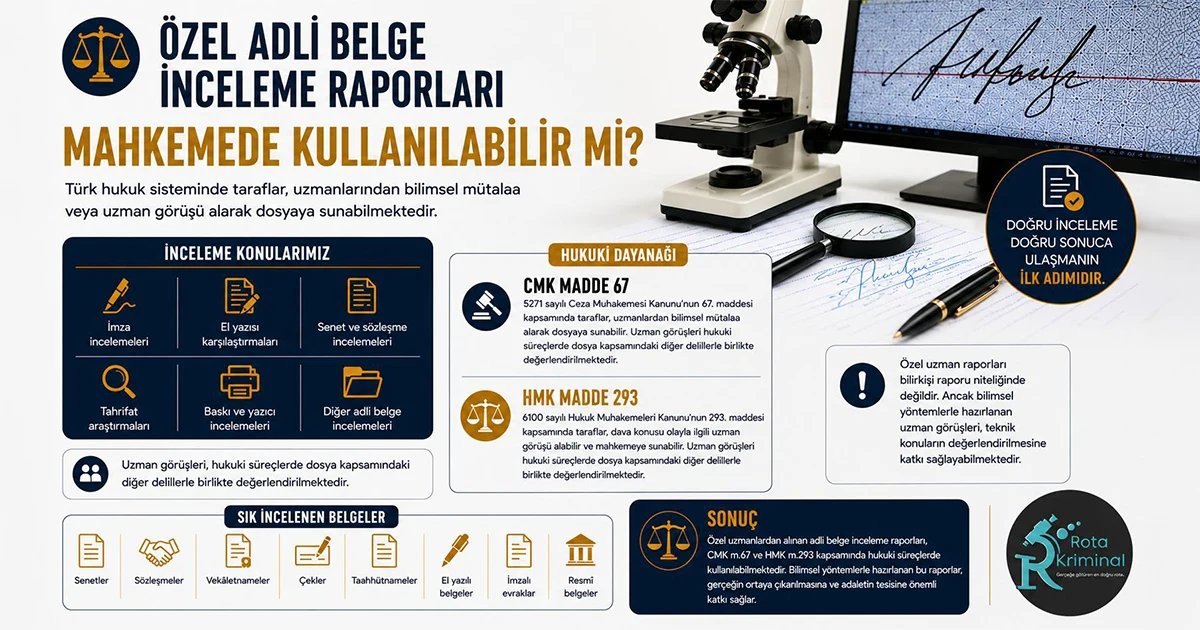
When a signature, handwriting or suspected forgery on a document becomes an issue, many people assume that only public institutions can carry out the examination. Today, however, experts and private laboratories able to prepare a private forensic document examination report can carry out independent assessments using scientific methods. So can reports obtained from these private experts be used in court? In this article, we explain the legal basis of private forensic document examination reports and their value in court.
Can Document Examinations Be Commissioned from Private Laboratories and Experts?
Yes. Signature attribution, handwriting comparison, examination of promissory notes (senet) and contracts, investigations into alterations and other forensic document work can be carried out by private experts. In this context, you can request an independent signature examination, and you can also obtain handwriting examination, print and printer analysis and document forgery investigations from private experts.
How Is the Examination Process Conducted?
Forensic document examination is not limited to visual assessment. Depending on the nature of the document, technical analyses are carried out using stereo and digital microscopes, UV–IR examination systems, oblique light techniques, image analysis software and advanced systems such as the Forenscope DocEx. These systems make it possible to examine details invisible to the naked eye and to reach scientific conclusions about the document. You can find detailed information on the equipment used in the process in our article on equipment used in forensic document examination.
What Is the Legal Basis?
In the Turkish legal system, the parties’ right to obtain an expert opinion is expressly regulated. A private forensic document examination report is therefore not an arbitrary assessment but a technical opinion with a basis in statute.
In Criminal Cases
Under Article 67 of the Turkish Code of Criminal Procedure No. 5271 (CMK), the parties may obtain a scientific opinion from their own experts and submit it to the case file.
In Civil Cases
Under Article 293 of the Turkish Code of Civil Procedure No. 6100 (HMK), the parties may obtain an expert opinion on the matter in dispute and submit it to the court. Thanks to these provisions, technical reports prepared by private experts can be taken into account in legal proceedings. You can review the scope of the expert opinion service you can request in detail.
Are an Expert Opinion and a Court-Appointed Expert’s Report the Same Thing?
These two concepts are often confused. A court-appointed expert’s report (bilirkişi raporu) is prepared by experts appointed by the court. An expert opinion or scientific opinion, on the other hand, is a technical assessment that the parties obtain from experts at their own request. The court may examine these opinions, compare them with the court-appointed experts’ reports, order a further examination if it deems necessary and hear the expert at a hearing. A private forensic document examination report therefore makes an important technical contribution to the legal process.
For Which Documents Can an Expert Opinion Be Obtained?
Forensic document examination can cover promissory notes, contracts, powers of attorney, cheques, written undertakings, wills, tenancy agreements, handwritten documents, signed papers and official documents. Examinations of eviction undertakings (tahliye taahhütnamesi), promissory notes and cheques and investigations into alterations on documents are among the most frequently requested types of examination.
Conclusion
Technical examinations carried out by private experts and laboratories in the field of forensic document examination can be treated as expert opinions with a recognised place in the Turkish legal system. Obtained under CMK Article 67 and HMK Article 293, these opinions help to clarify technical issues before a case is filed or during ongoing proceedings. What matters is that the examination is carried out using scientific methods, with suitable comparison material, by specialists in the field.
Frequently Asked Questions
Can a forensic document examination report obtained from private experts be used in court?
Yes. Under CMK Article 67 and HMK Article 293, the parties may obtain a scientific opinion from experts and submit it to the case file. A private forensic document examination report can therefore be taken into account in legal proceedings.
What is the difference between an expert opinion and a court-appointed expert’s report?
A court-appointed expert’s report is prepared by experts appointed by the court. An expert opinion is a technical assessment that the parties obtain from experts at their own request; the court may examine this opinion and compare it with the court-appointed expert’s report.
What equipment is used in forensic document examination?
The examination uses stereo and digital microscopes, UV-IR systems, oblique light techniques, image analysis software and advanced document examination systems such as the Forenscope DocEx, so that details invisible to the naked eye can be assessed scientifically.
Who can carry out a private forensic document examination?
Signature attribution, handwriting comparison, alteration and forgery examinations can be carried out using scientific methods by specialists in the field and by private laboratories.