A signature is not merely a name written on paper. It is the product of habits developed over years, of neuromuscular (nerve and muscle) memory and of motor reflexes that have settled over time.
This is why it is possible to imitate the shape of a signature; yet copying the speed, pressure and rhythm of the hand that writes it flawlessly is almost impossible.
WHAT DOES A FORENSIC DOCUMENT EXAMINER DO?
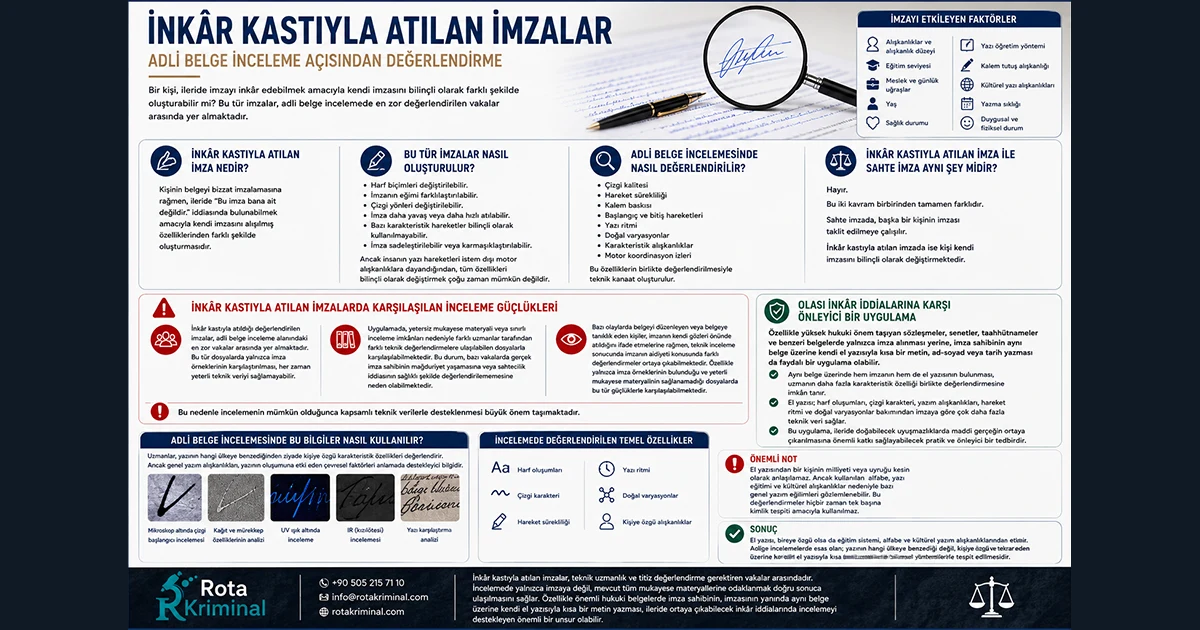
Forensic document examination exposes forged signatures through details that cannot be seen. In this process, magnification (microscopy), oblique light and comparative examination methods are used, together with advanced optical devices such as the Forenscope Document Examination system. The examiner looks not only at the shape of the signature but holistically at line quality, pressure distribution and continuity of movement.
Forenscope Technology
With the multispectral imaging devices used in our laboratory, even the slightest ink fluctuation in a signature is examined at 800x magnification.
1. WHAT DOES SIGNATURE EXAMINATION FOCUS ON?
In forensic signature examination, the following elements are assessed in particular:
- General Form: The position of the signature on the paper and its overall appearance.
- Arrangement and Connections: How the letters are joined to one another, and writing habits.
- Pressure Distribution: Where the pen is pressed down and where it is eased off.
- Speed and Fluency: Whether the signature was written in one sweep or with repeated stops.
- Rhythm: Natural hesitations and the “dance” of the pen.
Genuine signatures are usually fluent, fast and automatic. Forged signatures, by contrast, are controlled, slow and tense, because they are in effect “drawn”.
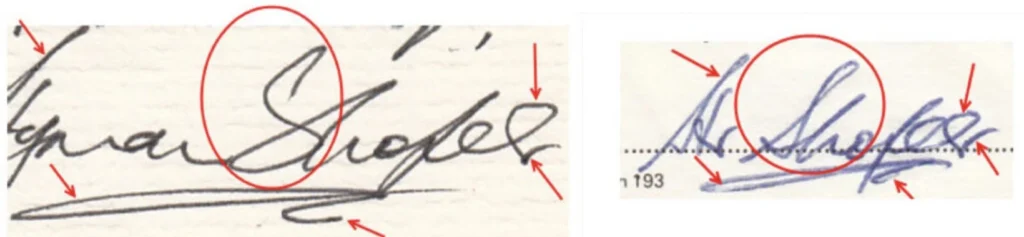
2. THE MOST COMMON SIGNS OF A FORGED SIGNATURE
These are the most basic mistakes that make a forger’s hand shake and give them away:
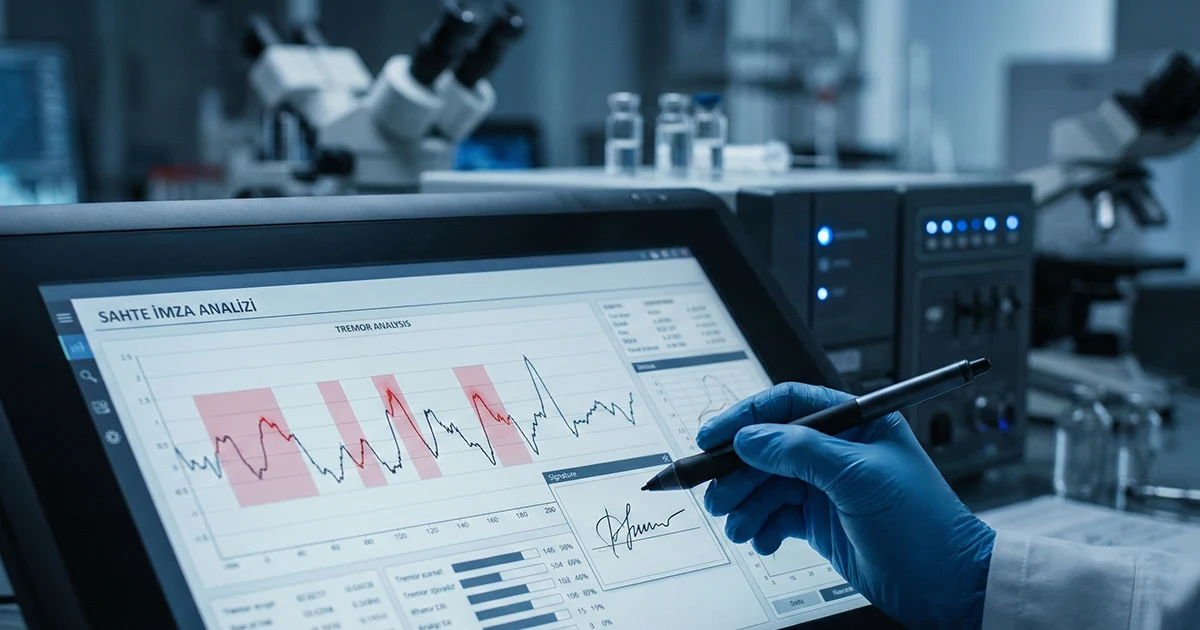
- Tremor: The more the imitator tries to match the original, the slower they write. In a slowed-down hand the natural oscillation disappears and microscopic tremors appear in the strokes.
- Hesitations: A genuine signature involves no pause for thought; it is written by reflex. In a forged signature the pen stops frequently, leaving ink accumulations.
- Pressure Inconsistency: In a natural signature, pressure is dynamic. In a forged signature, anxiety about imitation causes the pen to be pressed harder than necessary (static pressure).
- Proportion and Scale Errors: Letter heights and the spaces between letters are usually inconsistent.
📉 What Is Tremor?
A car moving fast drives straight; a car moving slowly has a wobbling steering wheel. The moment a forger slows the hand down to imitate a signature, invisible “breaks and tremors” appear in the strokes. This is the strongest evidence of forgery.
3. TYPES OF FORGED SIGNATURES
The types of forged signature most frequently encountered in forensic documents are:
- Freehand Simulation: The forger tries to reproduce the signature from memory. (For our detailed case analysis on this subject, click here: The Freehand Simulation Method)
- Copied Simulation: An imitation made while looking at an original signature placed in front of the forger.
- Tracing: Copying the signature using light from underneath or carbon paper. This is usually the easiest type of forgery to detect and the one that looks most “lifeless”.
4. DETECTION WITH LIGHT AND OPTICAL METHODS
In the laboratory, technology reveals what the naked eye cannot see:
- Oblique Light (Side Lighting): Shows the pen pressure impressions (indentations) on the back of the paper.
- UV / IR Light: Distinguishes additions made at different times or with different pens.
- Stereo Microscope: Reveals the “hook” structures at the beginnings and ends of strokes.
CONCLUSION
A signature never lies. A forgery always leaves a trace somewhere: a tremor, a hesitation or a wrong pressure point. Forensic document examination is the art of reading these traces with patience and science.
HAS YOUR SIGNATURE BEEN FORGED?
Don’t live with doubt: bring out the truth with a scientific report.
REQUEST AN EXAMINATION