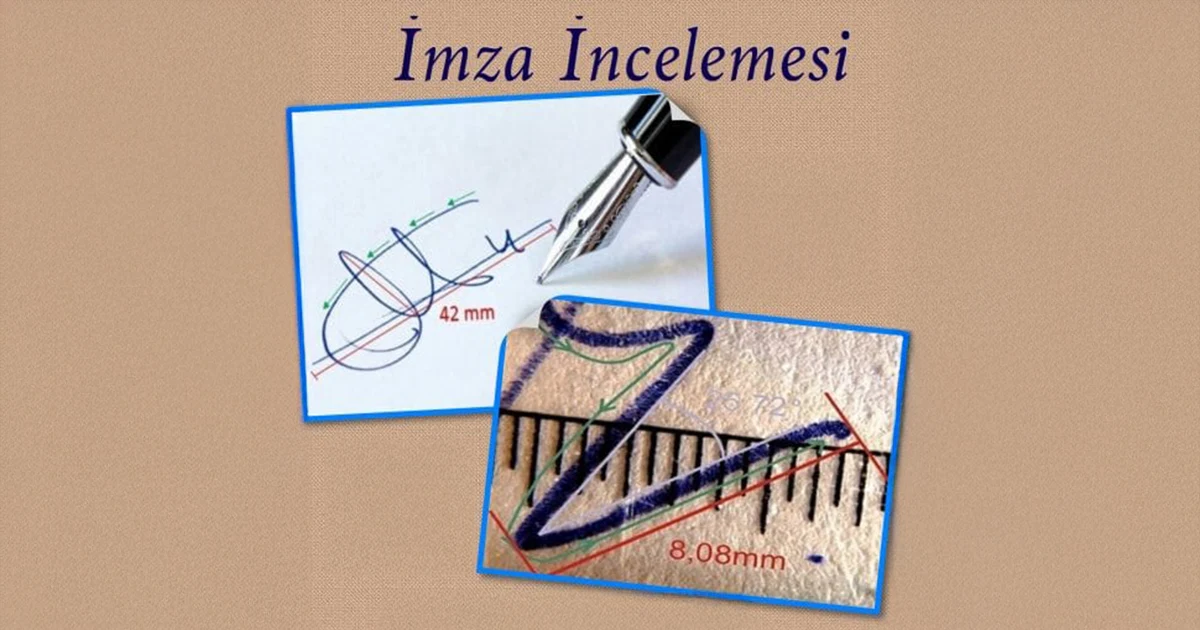
Signature forgery is the creation of a person’s signature against their will by another person or persons through copying, simulation, cut-and-paste montage, the use of a signing machine (autopen) or similar methods, and its use in a way that produces legal consequences.
The offences of “Forgery of Official Documents” and “Aggravated Fraud” under the Turkish Criminal Code (TCK), committed by means of a forged signature, are among the most common types of crime threatening commercial life worldwide and in Turkey. Valuable documents in particular – such as promissory notes (senet), cheques, contracts and land registry transfer records – are the number one target of forgers.
🛑 The 3 Most Common Forgery Traps
- 1. Freehand Simulation: Signatures the forger tries to produce from memory, showing heavy hand tremor.
- 2. Tracing: “Lifeless” lines traced using light from below or carbon paper.
- 3. Digital Montage: Signatures “cut and pasted” from another document, with distorted pixels.
HOW CAN A FORGED SIGNATURE BE IDENTIFIED?
Determining whether a signature is forged requires far more than a simple comparison with the naked eye. Professional forgers have mastered imitating the “picture” (the shape) of a signature. What they cannot imitate, however, is the signer’s neuromuscular (nerve–muscle) make-up and habits.
Forensic document examiners focus on the following critical parameters:
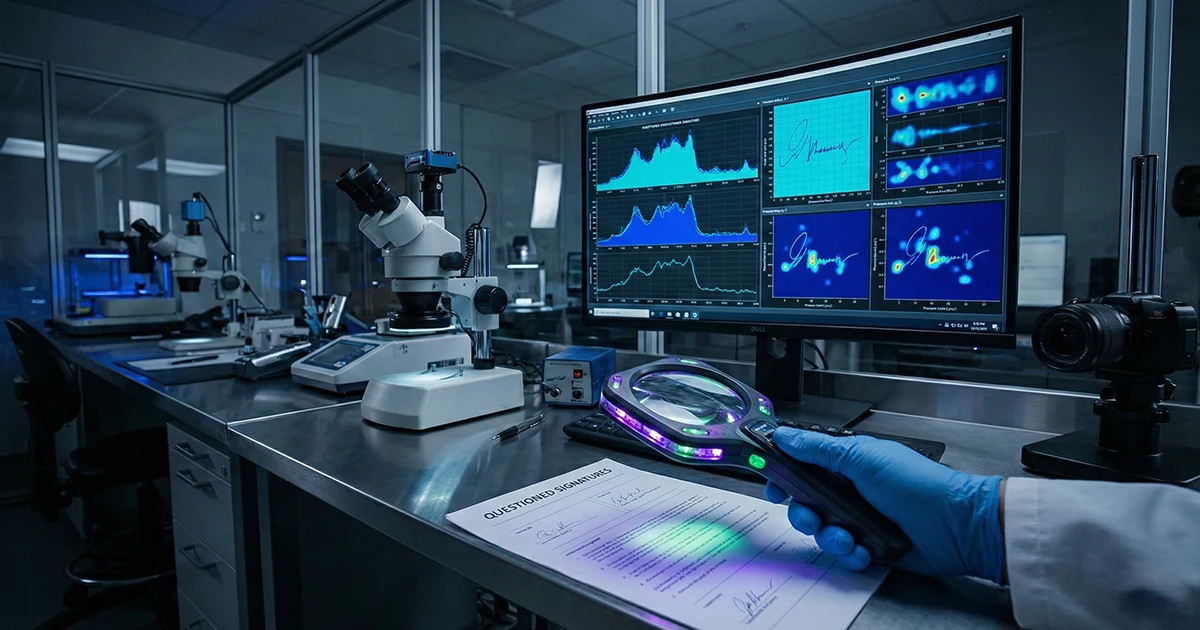
- Pressure Traces: The force with which a signer presses the pen onto the paper is individual. Forged signatures usually show either excessive pressure or faint traces caused by hesitancy.
- Speed and Acceleration: A genuine signature is fluent and unhesitating. In forged signatures, pauses, tremors and interruptions in speed resulting from the effort to imitate are detected.
- Starting and Ending Hooks: The microscopic movements at the moment the pen first meets and leaves the paper are the clearest evidence of forgery.
🔬 The Eye Can Be Deceived, the Microscope Cannot
The difference between a forged and a genuine signature is sometimes as small as a thousandth of a millimetre. With our high-resolution optical equipment, we analyse the distribution of ink in the paper fibres and demonstrate forgery scientifically.
GET A FREE INITIAL CONSULTATIONFORGERY METHODS AND THEIR DETECTION
The types of forgery most frequently encountered in forensic laboratories are:
- Simulation (Copying from a Model): The forger places the original signature in front of them and tries to reproduce it. Even if the shape is similar, the mismatch in speed and pressure is quickly revealed under the microscope.
- Tracing: The outline of the signature is traced using a light table or carbon paper. These signatures show an “unnatural”, lifeless and static structure.
- Montage (Digital Forgery): A genuine signature is scanned and transferred to another document with programs such as Photoshop. This method is detected through pixel analysis and differences in tone.
HAVE YOU FACED A SITUATION LIKE THIS?
Has a forged promissory note, cheque, contract or similar document been drawn up concerning you? Do you believe a forged signature has been made in your name? Or do you have doubts about whether the signature on a promissory note, cheque, contract or similar document given to you is genuine (i.e. whether it is really the debtor’s signature)?
This doubt can cause you significant financial and personal losses. In legal proceedings, “denial” alone is not enough; you need to prove your claim with a scientific report.
THE IMPORTANCE OF AN EXPERT OPINION
It is possible to establish the truth through meticulous, scientific examinations carried out with optical and technological equipment (Video Spectral Comparator – VSC, stereo microscopes) using handwriting comparison and graphometric methods.
As Rota Kriminal, with a detailed, illustrated Scientific Expert Opinion prepared under Article 67 of the Turkish Code of Criminal Procedure (CMK) and in line with the standards of the Turkish Court of Cassation (Yargıtay), we help you defend your rights in court and put your doubts to rest. Remember: there is no perfect crime (forged signature), only evidence waiting to be discovered.