
On Signature Forgery Detection and Forensic Science
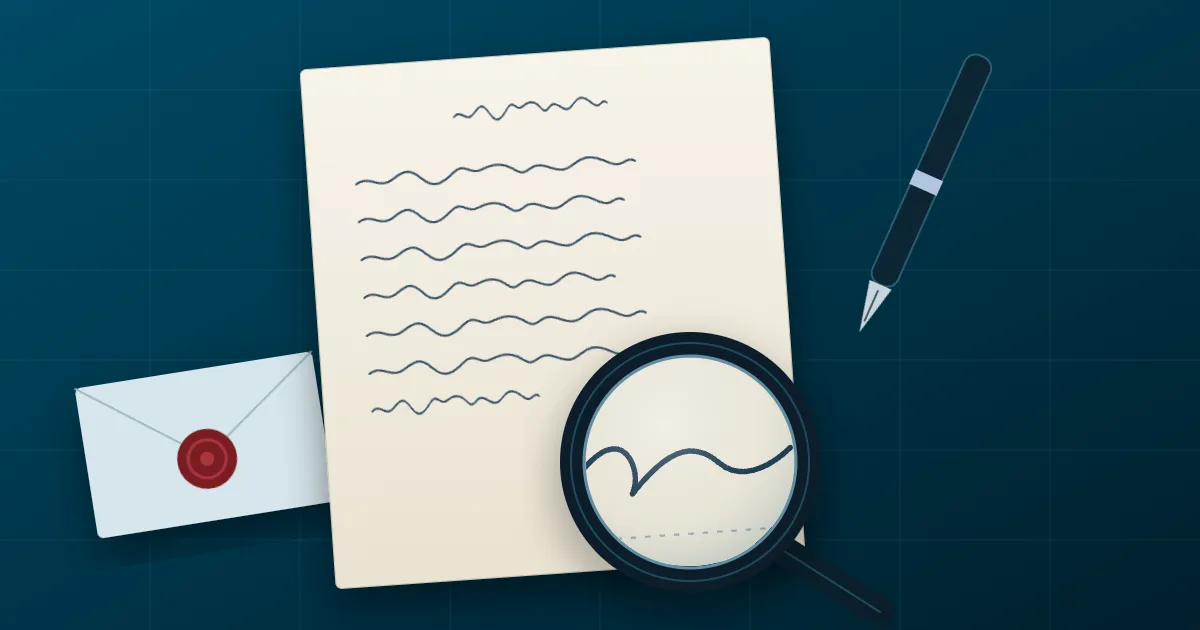
Throughout history, the signature has been one of the most fundamental means of verifying a person’s identity and ensuring the reliability of documents. For any official or private document to acquire legal validity, a signature is an indispensable requirement. The absence of a signature prevents a document from creating rights or obligations in the legal sense, which is why documents must be signed to be considered valid.
A signature is a personal mark that represents a person’s identity and contains individual calligraphic and characteristic features. In many countries around the world, it is common practice to sign by writing the first name and surname together, or one of them, in a stylised form. In Türkiye, however, even a mark made with a few simple lines can be accepted as a signature, which is why signatures on documents frequently become the subject of legal disputes.
⚠️ Critical Warning: A Simple Signature Is a Risky Signature!
In Türkiye, even “a few lines” are accepted as a signature. But remember: a simple signature takes seconds to imitate, while detecting the imitation becomes more difficult. Complex signatures that contain your first name and surname and reflect the character of your handwriting are your strongest security shield.
Signature forgery is today among the most common and serious offences. In Türkiye, too, signature forgery is one of the major problems causing individuals financial and non-financial losses. The main reason for this is that there is no requirement to sign in accordance with particular rules. In an environment where even simple lines count as a valid signature, it is inevitable that signature forgery will remain a widespread and dangerous offence. At this point, forensic handwriting examination plays a vital role in the administration of justice and helps to detect forgery.
The Scientific Foundations of Handwriting Examination
Forensic handwriting examination is a scientific discipline that studies people’s handwriting and signatures and analyses their authenticity and characteristic features. Using scientific and objective methods to detect forgery, it questions the genuineness of signatures. Because every person’s signature is a unique combination of neurological and motor skills, it is as individual as a fingerprint. This feature makes the signature a strong safeguard against forgery.
In signature examination, forensic document examiners take approximately 20-25 parameters into account: the general structure of the signature, its starting and finishing points, slant and direction, letter proportions, height and spacing relationships, the balance of rhythm and form, the fluency of the writing, the number of pen lifts and the way the signature is habitually finished are the key features that reveal whether a signature is forged or genuine.
🔬 5 Golden Criteria in Signature Analysis
Our experts look not only at the shape of a signature but at its very nature:
- ✅ Pressure Trace: The force the pen applies to the paper.
- ✅ Speed and Acceleration: The unhesitating fluency of the signature.
- ✅ Hiatus (Pen Lift): The invisible path the pen travels through the air.
- ✅ Start & Finish: Hooks that have become reflexive.

Examining Forged Signatures: Methods
In their signature examinations, forensic document examiners focus on approximately 20-25 different parameters. Elements such as the general structure of the signature, its starting and finishing points, letter proportions, slant and direction, height and spacing relationships, the fluency of the writing and the number of pen lifts offer important clues for establishing whether a signature is genuine or forged. Forged signatures are generally produced by different methods: tracing over the original, copying while looking at it, freehand simulation, cut-and-paste montage or the use of an autopen (signature machine). Each method leaves distinctive traces, and telling these traces apart requires expertise.
The Role of Technology in the Forensic Examination Process
Forensic document examiners use advanced devices and techniques to verify allegations of signature forgery:
- Microscopic Examination: Elements such as how deeply the ink has penetrated the paper and the continuity of the strokes are examined in detail.
- UV (Ultraviolet) and IR (Infrared) Filters: By analysing how the ink responds at different wavelengths, differences between forged and genuine signatures are revealed. This technique is extremely effective in identifying different types of ink.
The Importance of Forensic Handwriting Examination in Legal Proceedings
Handwriting examination reports submitted to the courts are regarded as evidence important enough to shape the course of a case. In fraud cases in particular, detecting a forged signature is a critical step in protecting the victim’s rights and reaching a fair outcome. The expert opinions of forensic document examiners serve justice by helping to resolve legal disputes.
Technology and Advanced Examination in the Fight Against Forgery
Although technology has made forgery more sophisticated, it has also strengthened detection methods. Forged signatures produced with high-resolution printers and digital tools have become almost impossible to distinguish with the naked eye. However, forensic examination equipment and software have been developed to overcome this challenge. Experienced forensic document examiners make an important contribution to solving forgery cases by analysing even the finest details.
Conclusion and Recommendations
Establishing the authenticity of signatures and protecting their reliability is of great importance for defending individuals’ legal rights. For the security of official documents, individuals are advised to protect their signatures both digitally and physically. Using a signature that is hard to imitate and carries characteristic features also provides additional protection. When faced with a suspicious situation, consulting experts in forensic handwriting examination is an important step in preventing financial and non-financial losses. Forensic handwriting examination continues to be a powerful scientific discipline that, as a guardian of justice, supports the rule of law and public trust. In this way, it contributes to the administration of justice and strengthens society’s faith in the legal system.