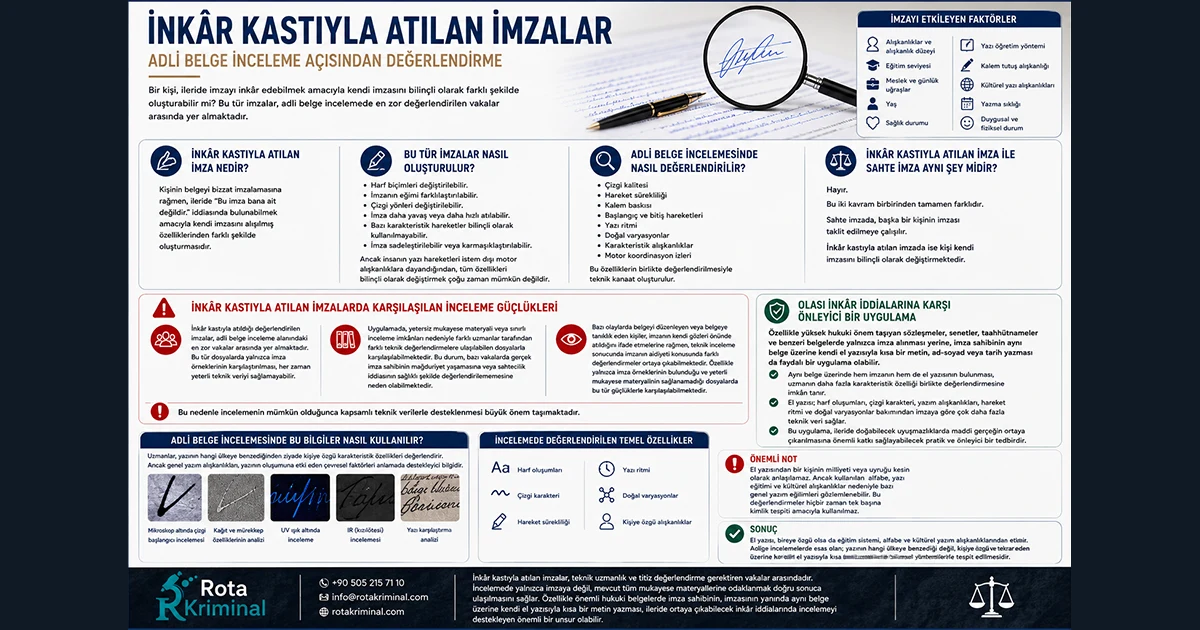

Forged Signatures: Detection Methods, Penalties and Court Proceedings
A forged signature is a signature made in a person’s name without their knowledge or consent, or produced by imitating their genuine signature. In Turkey, thousands of contracts, powers of attorney and official documents end up in court every year on allegations that they bear forged signatures. In this guide we take a comprehensive look at the scientific detection of forged signatures, the sanctions under the Turkish Criminal Code (TCK) and the steps to follow in court proceedings.
As Rota Kriminal, having produced scientific evidence in thousands of signature examination cases over many years, we have prepared this content for lawyers, judges and right holders, bringing all aspects of the subject together in a single resource.
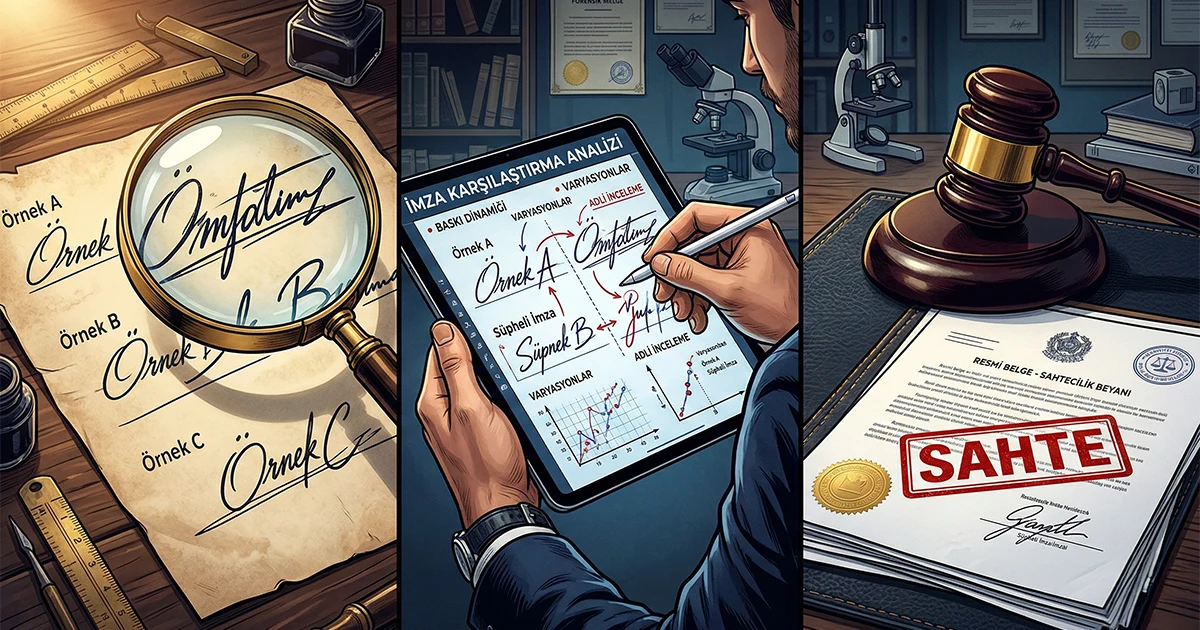
What Is a Forged Signature?
In legal terms, a forged signature covers any signature made in the name of the genuine signatory without their consent, or produced by copying. A forged signature is not only a wrong; under Turkish law it is a criminal offence carrying severe sanctions.
Types of Forged Signatures
Simulated Signature: A signature the forger deliberately imitates, either with the genuine signature in front of them or from memory. This is the most common type. In forensic examination it is identified through inconsistencies in tremor and pressure distribution.
Traced (Copied) Signature: A method in which the genuine signature is transferred exactly by placing semi-transparent paper over it or using a light box. Dimensional distortions and the ink structure give this method away.
Freehand Invented Signature: A signature the forger devises without seeing any reference. It does not match the genuine signatory’s graphomotor habits.
Altered (Tampered) Signature: Parts of the genuine signature are manipulated to give it a different meaning. It is detected by examination for alterations.
Find out more about why you should not use a simple signature.
How Is a Forged Signature Detected?
In comparative signature analysis, the questioned signature is compared with the signatory’s reference signatures in terms of graphomotor characteristics. Speed, slant, proportion and direction of movement are assessed.
Tremor Analysis: In simulated signatures, slow and careful movement leaves traces of pathological tremor. These traces are detected with a VSC (video spectral comparator) and a stereomicroscope.
In pen pressure and ink trace analysis, it becomes clear that forgers cannot fully reproduce the pressure and ink pattern of a genuine signature.
Optical (UV/IR) Examination: Ultraviolet and infrared light sources make ink layers and hidden manipulations visible.
However skilled a forger may be, they cannot replicate another person’s motor memory exactly; this difference emerges even with methods that are hard to detect.
Legal Consequences of a Forged Signature
TCK Article 204 — Forgery of Official Documents: A forged signature on a title deed, notarial document or official contract carries a prison sentence of 2–5 years for private individuals and 3–8 years for public officials.
TCK Article 207 — Forgery of Private Documents: A forged signature on a lease agreement, release (ibraname) or other private document between individuals carries a prison sentence of 1–3 years.
TCK Article 212 — Use of a Forged Document: A person who did not create the forged document but knowingly uses it is tried under the same penal provisions. Find comprehensive information on forged signature penalties and the objection process.
How Do Court Proceedings Work?
- Complaint: The injured party files a complaint with the Public Prosecutor’s Office. Forgery of official documents can be investigated ex officio.
- Securing the Evidence: The suspicious document is seized and kept in safe custody. Any interference with the document reduces its evidential value.
- Court-Appointed Expert Examination: The court or the prosecutor’s office refers the document to a forensic expert. The expert carries out a scientific comparison with reference signatures and prepares a written report. This report determines the course of the case.
- Trial: An indictment is drawn up and the case is heard before the high criminal court (ağır ceza mahkemesi). The parties may question the expert and request a further expert examination.
- Judgment and Appeal: The decision can be reviewed on appeal (istinaf) and then before the Turkish Court of Cassation (Yargıtay).
What Should You Do in Signature Denial Cases?
Do not fold the original document or write on it, and obtain an expert opinion before copying it. Gather reference signatures with reliably documented dates (bank documents, notarised papers). Obtaining an independent private expert opinion before proceedings begin strengthens both your negotiating position and your standing in court.
If enforcement proceedings (icra takibi, the Turkish debt enforcement procedure) have been started against you on the basis of a promissory note (senet) bearing a forged signature, the time limit is very short. In enforcement based on a negotiable instrument, an objection to the signature must be filed with the enforcement court within five days of service of the payment order (Enforcement and Bankruptcy Law (İİK) Arts. 168 and 170). If this deadline is missed, the signature is deemed accepted and the forgery can then only be raised through an action for a negative declaratory judgment (menfi tespit davası). To pursue the objection and the criminal complaint together, consulting a lawyer in Adana, for example a firm handling enforcement and criminal cases such as Ulukat Hukuk & Arabuluculuk Ofisi, will clarify which route to take depending on the state of the file.
Find out more about the forensic detection of forged signatures and signature examination procedures. See also the related pages on the place of signature examination in forensic science and the legal importance of the wet ink signature.
Frequently Asked Questions
What is the penalty for a forged signature?
A forged signature on a private document carries 1–3 years' imprisonment (TCK 207); on an official document it carries 2–5 years for private individuals (TCK 204/1) and 3–8 years for public officials.
How is a signature denial case brought?
An investigation begins when the party claiming the signature is forged files a complaint with the Public Prosecutor's Office. The expert report becomes the most decisive evidence in the proceedings.
Is a contract with a forged signature valid?
No. A contract bearing a forged signature has no legal effect, and its annulment can be sought through the courts.
How long does a signature examination take?
At Rota Kriminal, a standard signature examination is completed in an average of 5–10 working days. An express examination option is also available for urgent cases.