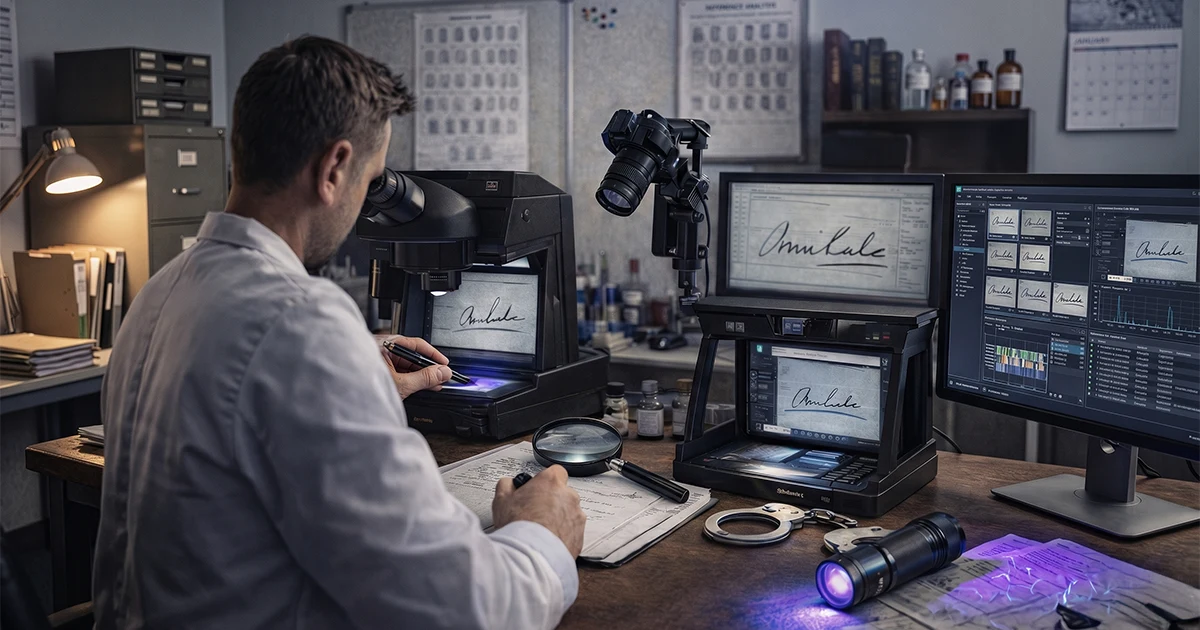
What Is a Forensic Document Examiner?
A forensic document examiner is a qualified forensic specialist who uses scientific methods to analyse the authenticity of official and private documents such as cheques, promissory notes (senet) and contracts, whether they have been altered (tampered with), and to whom a signature or handwriting belongs.
A professional forensic document examination never relies on a routine check with the naked eye or on personal interpretation. The process is conducted entirely on the basis of scientific, measurable and concrete comparative data. Reports prepared from these findings are submitted as expert opinions in court and in all legal proceedings, and can be among the strongest evidence capable of changing the course of a case.
What Kind of Work Does a Forensic Document Examiner Do?
Forensic document examiners carry out a multi-faceted technical analysis of any document suspected of forgery. The fundamental aim of this work, carried out in a forensic laboratory environment, is to establish scientifically the document’s legal validity, its authorship and whether it has been manipulated in any way. The most common areas of work for a forensic document examiner at Rota Kriminal are:
- Signature Examination: Detecting forged, imitated or transferred signatures.
- Handwriting Comparison: Attributing questioned writing by comparison with reference samples.
- Detection of Forged Documents: Verifying the authenticity of valuable documents such as passports, identity cards, cheques and promissory notes.
- Alteration Analysis: Identifying dates, figures or text added to a document after the fact.
- Ink and Writing Inconsistencies: Detecting the chemical and physical traces left by different pens or by differences in time.
- Detection of Physical Interference: Optical examination of erasures, scraping and chemical alteration on the document.
The ultimate goal of all this work is to establish, beyond reasonable doubt, how, by what method and by whom the forgery was carried out.
Our Areas of Expertise
How Is a Forensic Document Examination Carried Out?
Forensic document examination is a multi-stage, disciplined process that aims to reduce the margin of error to zero. In the Rota Kriminal laboratory, every document goes through the following five basic stages in line with international standards:
- Preliminary Examination: The general paper structure, security features and physical condition of the document are assessed. An initial surface analysis of signatures and writing is made at this stage.
- Comparison (Collecting Reference Material): A comparison pool is built by collecting genuine (contemporaneous) signatures of the person concerned from previous years and current writing samples (samples taken in the presence of the court).
- Technical Analysis: 25-30 universal parameters, such as line quality, pressure distribution, fluency of movement, the balance of proportion and form, and characteristic writing habits, are examined in detail.
- Optical Examination: Using some of the most advanced document examination systems available, such as the Forenscope DocEx, line structures invisible to the naked eye, different ink layers and hidden details under UV light are brought to light.
- Scientific Reporting: All the data obtained are combined using objective criteria and turned into a comprehensive expert report with strong evidential value in legal proceedings.
Preliminary Analysis and Screening
Verifying the physical condition and basic security features of the document.
Comparison Material
Collecting reliable reference data and building the comparison set.
Microscopic Parameter Analysis
Examining pressure, speed and habitual writing features against 25+ criteria.
High-Tech Optical Scanning
Analysis of layered ink and hidden details with the Forenscope DocEx.
Formal Report Preparation
Turning scientific data into an expert opinion written in legal language.
Which Methods Are Used in Forensic Document Examination?
Forensic document examination is an interdisciplinary field where advanced technology meets in-depth expertise. The methods used in our laboratory are designed to reveal even the most hidden details without damaging the physical and chemical structure of the document:
- Microscopic Examination and Magnification: Line structure and the beginnings and ends of strokes are analysed at micron level.
- Oblique Light Techniques: Light directed at the document at specific angles reveals pressure impressions and scraped areas on the paper.
- VSC (Spectral) Analysis (UV and IR): Using the ultraviolet and infrared light spectra, different inks, hidden security features and erased writing are made visible.
- Comparative Handwriting Analysis: Questioned signatures and writing are compared scientifically with reference data in terms of speed, pressure, slant and habits.
A forensic document examiner needs more than the ability to operate equipment in order to apply these techniques correctly: it requires in-depth experience of writing dynamics, ink chemistry and document production processes. Document examination is not a superficial observation; it is a professional process of expertise that requires a scientific approach.
Optical Analysis
Detailed examination of line quality and ink distribution through microscopic magnification.
Light Spectrum
Detecting alterations invisible to the naked eye with UV and IR (infrared) light analysis.
Graphometric Analysis
Mathematical measurement of pressure, speed and habitual features in writing and signatures.
Expert Opinion
The process of turning technical findings into a scientific report that meets legal standards.
The Most Common Cases in Forensic Document Examination
Although fraud and forgery methods are becoming more varied, for a forensic document examiner the cases most frequently encountered in criminal investigations fall under a few main headings. The main types of forgery identified through Rota Kriminal’s expertise are:
- Forged and Imitated Signatures: However closely an imitation is made to resemble the original, it cannot match the speed, pressure balance and fluency of the genuine signature. In forensic analysis, such signatures usually give themselves away through “monotonous, static and shaky” lines.
- Misuse of a Blank Signature (Documents Filled in Afterwards): One of the most common cases is the addition, without consent, of text or an amount above a signature that was placed on a blank sheet or document on the basis of trust.
- Document Manipulation and Content Alteration: Documents signed for another purpose are turned into a promissory note or contract by changing the writing on them through physical or chemical means (erasure, scraping, etc.).
- Montage and Digital Forgery: The original signature on a document is cut out digitally via photocopying or scanning and transferred to another, forged document. Such cases are detected through analysis of pressure impressions and line quality.
✍️ Forged Signature
Imitation attempts made with shaky, monotonous lines that lack the characteristic features of the original signature.
📄 Blank Signature Abuse
Adding text or debt-creating terms above a previously placed signature without the person’s knowledge or consent.
⚗️ Chemical Alteration
Forgery carried out by erasing the writing on a document with chemical solvents and writing new data in its place.
🖥️ Digital Montage
Scanning a genuine signature and copying it digitally onto another document.
Technical Forgery Methods Used on Documents
Forensic document examiners analyse not only the content of documents but also the physical interaction between paper and ink. The technical manipulations most frequently identified by a forensic document examiner in a professional laboratory environment are:
- Content Conversion: The original writing on documents signed for another purpose is erased by physical or chemical means, and the signed blank area is turned into a promissory note or contract.
- Digital Cloning (Photocopy/Scan): A genuine signature on a document is reproduced using high-resolution scanners or photocopying and transferred onto forged documents. Because the natural pressure impressions of the signature and the flow of the ink are lost in this process, examiners can readily distinguish it.
- Interference with a Different Pen and Ink: In later additions to a document, the use of inks with a different chemical composition, even if they look the same at first glance, is the most concrete finding.
- Text and Amount Manipulation: Changing the form of figures on cheques, promissory notes and contracts (for example turning a 1 into a 7) or adding new words in blank spaces is brought to light through analysis of writing characteristics and microscopic examination.
Technical Analysis Parameters
Field of Expertise and Professional Approach
Forensic document examination, and the work of the forensic document examiner, is not merely a technical process of operating advanced equipment. The discipline demands a very deep body of knowledge and experience, ranging from human psychology to writing dynamics and from motor behaviour to document production processes.
A professional forensic document examiner evaluates:
- Writing Habits: the characteristic movements a person acquires over time and puts on paper involuntarily,
- Signature Characteristics: dynamic elements that shape a signature, such as speed, slant and pressure,
- Technical Findings: concrete physical data obtained in the laboratory,
- Results of Optical Analysis: microscopic details identified with devices such as the Forenscope DocEx,
as a whole. The solutions offered by Rota Kriminal are based not on a single finding but on a holistic, objective and scientific approach. It should be remembered that a correct analysis can change lives, while a wrong opinion misleads justice. Rather than leaving the process to chance, acting on concrete evidence supported by an expert opinion is always the safest course.
Holistic Scientific Approach
The Invisible World of Documents and Forensic Expertise
For a forensic document examiner, the examination process is a scientific foundation built on measurable parameters and comparative analysis, going beyond superficial similarities. Every signature and every piece of handwriting is a unique reflection on paper of a person’s muscle memory, motor behaviour and writing habits ingrained over the years. This is why even the most professional forgery attempts inevitably leave indelible traces in microscopic technical features such as line quality, pressure distribution and continuity of movement.
Today, advanced optical systems and analysis methods such as the Forenscope DocEx can reveal alterations on a document that are invisible to the naked eye. However, these data can only acquire evidential value through high-level expertise and a methodical assessment.
Ultimately, for a forensic document examiner, however well manipulations on a document are concealed and however skilfully signatures are imitated, a person’s individual calligraphic characteristics and the technical findings can never remain hidden from scientific examination. Correct analysis is the strongest foundation for justice to be done.
Do You Have Doubts About the Integrity of Your Document?
For cases involving forged signatures, alterations or suspicious documents, we provide expert opinions prepared with scientific methods for use in court proceedings, as well as technical support in relation to court-appointed expert reports.
Get a Free Initial Consultation