How Is a Forged Signature Detected?
A signature is not a simple scribble on a piece of paper; it is a reflection of a person’s neurophysiological make-up, muscle memory and individual characteristics. As the most fundamental biometric marker used to confirm a person’s identity in legal transactions, the signature is unfortunately also the element most often forged. From the standpoint of forensic science, however, there is no such thing as a perfect forged signature. A person can imitate the shape of someone else’s signature, but cannot copy the motor habits, pen pressure and speed rhythm that person has developed over the years. At Rota Kriminal, we use the latest technology and scientific methods to combat forgery.
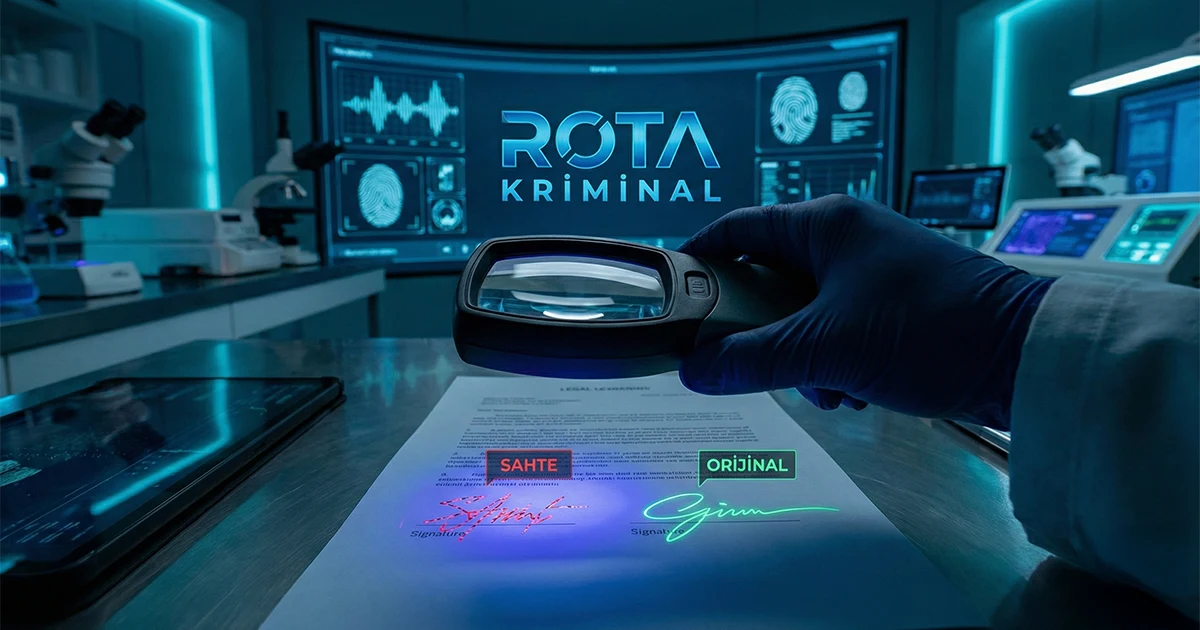
FORENSCOPE ANALYSIS
We detect ink residues and paper deformations invisible to the eye using multispectral light sources.
1️⃣ How Is a Forged Signature Detected?
Detecting forged signatures is far more than a visual “does it look alike” exercise. The forger focuses only on the outward appearance of the signature. While trying to reproduce the shape, however, they lose the “soul” of the signature, that is, its natural flow. In laboratory examinations, our examiners focus on the following key findings that give a forged signature away:
- Tremor and Hesitation: The genuine signatory signs without thinking, at reflexive speed. The forger, on the other hand, moves slowly “so as not to make a mistake”. This slowness causes tremors and breaks in the lines at microscopic level.
- Pen Lifts: The forger lifts the pen from the paper at unnecessary points to check the course of the signature or to look at the original model. These pauses create ink blobs and unnatural gaps.
- Patching and Retouching: Going back over parts of the imitated signature that look wrong or incomplete is one of the most common signs of an amateur forgery found in forensic examination.
- Tracing: When the original signature is copied by holding it up to a light or using carbon paper, the signature looks excessively “neat” but “lifeless”. Pressure variations disappear and the line width is the same everywhere.
Legal Validity
Our expert opinions are prepared in line with the standards applied by the Turkish Court of Cassation (Yargıtay) and can be submitted as evidence in court proceedings.
2️⃣ How Can You Tell Who a Signature Belongs To? How Is a Forged Signature Detected?
Establishing the authorship of a signature is an in-depth handwriting and forensic analysis carried out in order to be able to say “this signature belongs to person X”. Similarity of shape alone does not prove that a signature belongs to that person, since well-executed imitations are also similar in shape. How is a forged signature detected?
Genuine authorship is established using the following parameters:
- Pressure (Indentation) Analysis: Everyone presses the pen onto the paper with a different force. Some press harder on the upstrokes of letters, others on the downstrokes. This relief map formed on the back of the paper is as unique as a person’s fingerprint.
- Speed and Acceleration Profile: The starting speed of the signature, the slowing down at turns and the final flick of the pen (the release point) contain a rhythm unique to the individual.
- Starting and Finishing Points: The point where the pen first touches the paper and the last point where it leaves it are the reflexive movements hardest to imitate.
- Reference (Comparison) Material: The questioned signature is placed side by side with signatures the person gave in the presence of the court (istiktap) and with genuine, contemporaneous signatures from the past (bank receipts, old contracts), and the consistency of the characteristic features is examined.
3️⃣ How Is a Forensic Signature Examination Carried Out?
Forensic signature examination is carried out in Rota Kriminal’s laboratories using optical equipment and software that meet international standards. This process is free from subjective interpretation and based entirely on technical data.
Our examination stages include:
- Macro Examination: Identifying the general structure of the document, the type of paper and any abnormalities visible to the eye.
- Stereo Microscopy: Determining ink distribution, line intersections and the direction of pen movement (ductus) at high magnification (40x – 100x).
- Multispectral Analysis (Forenscope): Analysis using light spectra the human eye cannot see.
- UV (Ultraviolet) Light: Reveals erasures, scraping or chemical interventions on the paper.
- IR (Infrared) Light: Exposes additions made at different times with different pens (for example, figures tampered with afterwards on a promissory note (senet)).
- Oblique Light (Side Light) Examination: The method that shows pressure marks and indentation details on the paper surface most clearly.
4️⃣ Will a Forged Signature Come to Light?
Yes, it certainly will. No forgery attempt can remain hidden when scientific methods are applied. How is a forged signature detected?
Imitating a signature is a battle between the conscious part of the brain (the cortex) and the unconscious (motor memory). While the imitator consciously tries to reproduce the shape, they have to suppress their own hand habits. Human physiology, however, does not allow this. Forensic examiners detect the micro traces that this “biological conflict” leaves on the paper.
However skilled they may be, it is neurologically almost impossible for anyone to imitate, simultaneously and flawlessly, the muscle memory, pen grip angle and speed rhythm that another person has developed over years. For this reason, an examination carried out with the right equipment and an expert eye detects forgery with close to 100% accuracy.
99.9% Accuracy
Conclusive results that leave no room for doubt, based on scientific data.
5️⃣ How Long Does Forged Signature Detection Take?
How is a forged signature detected? We are aware of the time pressure that legal proceedings and commercial disputes bring. That is why, at Rota Kriminal, we work on the principle of “fast solution, firm result”. The examination period may vary depending on the number of documents in the file and the complexity of the case, but our standard procedure is as follows:
- Preliminary Review (First 24 Hours): Once the document reaches us, our examiners carry out an initial screening of the file and determine the roadmap to follow.
- Detailed Analysis and Reporting (48 – 72 Hours): This is the stage of detailed examination with optical equipment in the laboratory, marking of the findings and writing of the reasoned expert report (private expert opinion).
Our reports are delivered in a format designed to be used as evidence before courts, public prosecutors and official authorities, in line with the standards applied by the Turkish Court of Cassation (Yargıtay), supported by images and with their scientific basis clearly stated. How is a forged signature detected?
Conclusion and Assessment
Detecting a forged signature is not a simple matter of “in my opinion”; it is a technical process that brings together physics, chemistry and handwriting examination. Similarity can be misleading, but scientific data never lie. When you encounter a suspicious situation, preserving the original document and requesting a professional forensic examination without delay is vital to avoid losing your rights. We have tried to answer the question of how a forged signature is detected.
Rota Kriminal has all the technological infrastructure and expertise needed to bring the truth to light.