

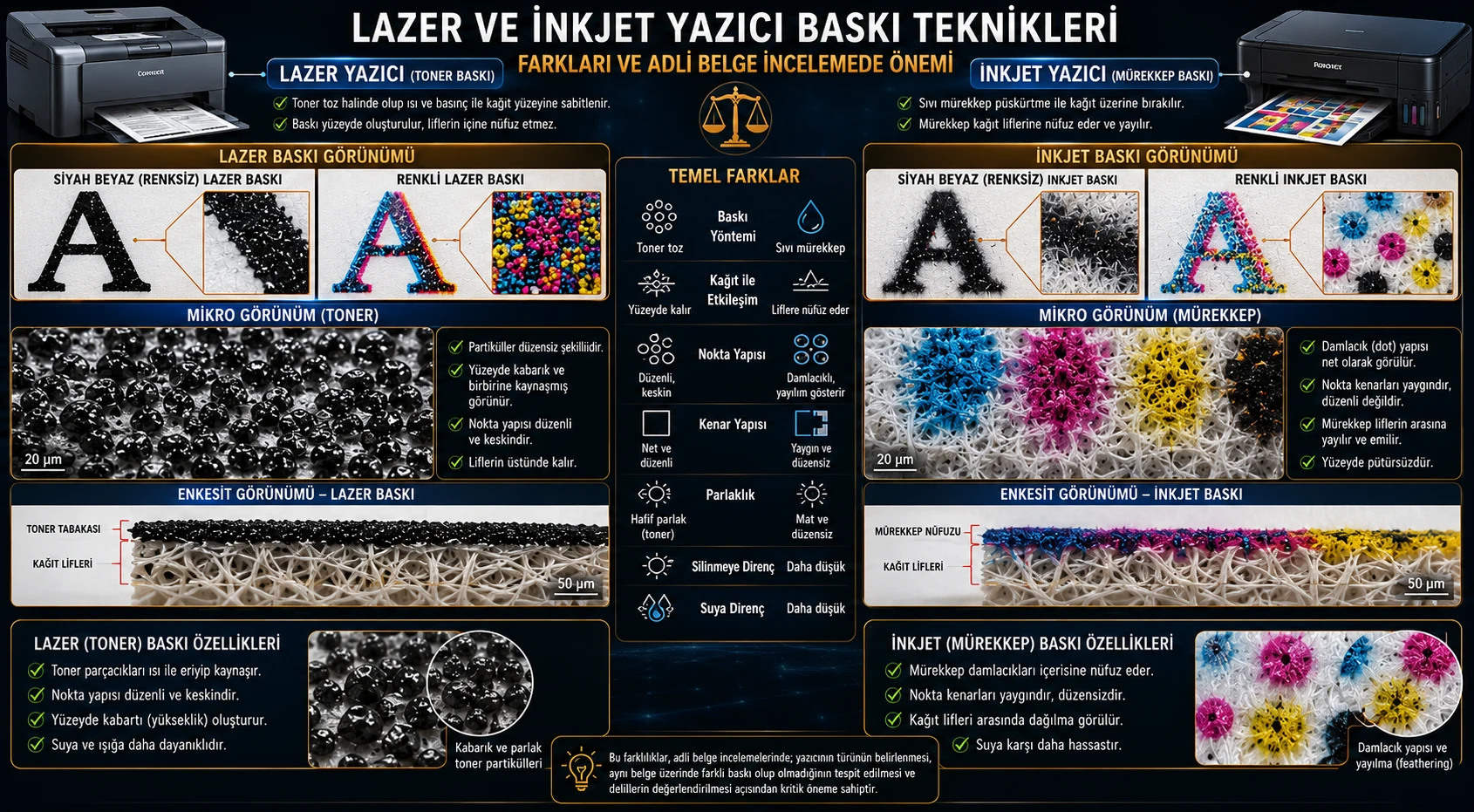
Today, a great many documents, from official papers and contracts to promissory notes (senet) and various corporate records, are produced on printers. Yet how the print on a document was produced can provide important information for forensic document examination. Laser and inkjet printers in particular work on different principles, so they leave different traces on a document. These differences can play an important role in assessing whether a document has been tampered with afterwards, whether different printers were used on the same document, and in evaluating certain forgery attempts.
What Is a Laser Printer?
Laser printers carry out the printing process using an electrophotographic system. In its working principle:
- Laser beam
- Electrostatic charge
- Toner particles
- Heat and pressure system
work together to produce high-quality print. In this process, fine powder particles called toner are transferred onto the paper surface and permanently fixed with the help of high temperature. The result is a sharp, clear print characteristic that sits on the surface.
Characteristics of Laser Printers
Laser printers also produce a distinctive print profile from the perspective of forensic document examination:
What Is an Inkjet Printer?
Inkjet printers create print by spraying liquid ink onto paper in very small droplets. Three basic components work together in this system:
Liquid Ink Cartridges
Print Heads
Microscopic Droplets
Unlike with laser printers, the ink does not stay on the paper surface; it is absorbed directly by the paper fibres and penetrates into them.
Characteristics of Inkjet Printers
Unlike the laser system, inkjet printers interact directly with the structure of the paper. Instead of staying fixed on the surface, the ink soaks into the paper fibres. This fundamental difference leaves a series of characteristic traces in the print, chief among them a dot-like droplet structure, slight spreading at the edges and variability depending on paper quality. Inkjet printers, which perform well in colour printing, create their own distinctive print profile that sets them apart from laser printers in forensic document examination.
Key Differences Between Laser and Inkjet
Printers
Importance in Forensic Document Examination
In document forgery cases, different printing systems may be used on the same document. For example, a date added later to an original contract, a changed figure or additional information printed on a different printer leaves distinct characteristic traces on the document. This is where the differences between the print profiles of laser and inkjet printers become a critical source of data for the forensic document examiner. The use of two different printing systems on the same document plays a decisive role in revealing both the existence and the nature of the interference.
Technical Examination Methods Used
Advanced technical systems are used in forensic document examination to identify differences between laser and inkjet printing. High-magnification digital microscopes, UV and IR examination systems, oblique light methods, print analysis systems and advanced imaging devices such as the Forenscope DocEx are the main tools used in this process. These systems make differences in print layers and toner and ink characteristics that cannot be seen with the naked eye visible, so that they can be assessed scientifically.
Laser or Inkjet? The Details That Make the Difference in Forensic Document Examination
Laser and inkjet printers are not just different printing technologies; they are two different systems that leave technically distinct traces on a document. Toner structure, print characteristics and the way they interact with paper provide important technical data in forensic document examination. One of the most critical features of laser printers in forensic document examination is the toner structure. Made up of fine particles containing plastic, pigment and various additives, toner may, under microscopic examination:
- Form a raised structure on the surface
- Show particular distribution characteristics
- Create different densities at the print edges
- Interact differently with the paper fibres
When assessed with the right methods and scientific analysis, these small differences on a document make a decisive contribution to the examination process.
Frequently Asked Questions
What is the difference between laser and inkjet printers?
Laser printers fix fine powder particles called toner onto the paper surface using heat and pressure, while inkjet printers spray liquid ink in microscopic droplets onto the paper fibres, which absorb it. This fundamental difference creates distinct print characteristics on a document.
Why is the difference between laser and inkjet printers important in forensic document examination?
In document forgery cases, different printing systems may be used on the same document. A date added later, a changed figure or added information leaves different print characteristics. Forensic document examiners can detect these differences and thereby expose forgery attempts.
Which methods are used in printed document examination?
Forensic document examination uses high-magnification digital microscopes, UV and IR examination systems, oblique light methods and advanced imaging systems such as the Forenscope DocEx. These systems make differences in print layers that cannot be seen with the naked eye visible.
Why is toner structure important in forensic document examination?
Toner consists of fine particles containing plastic, pigment and various additives. Under microscopic examination it can form a raised structure on the surface, show particular distribution characteristics and interact differently with the paper fibres, which is why it provides critical technical findings in forensic examination.
How can you tell whether different printers were used on a document?
During the examination, experts assess toner distribution, print density, edge structures, microscopic characteristics and print layers. The use of different printing systems on the same document can be established scientifically through these parameters.