
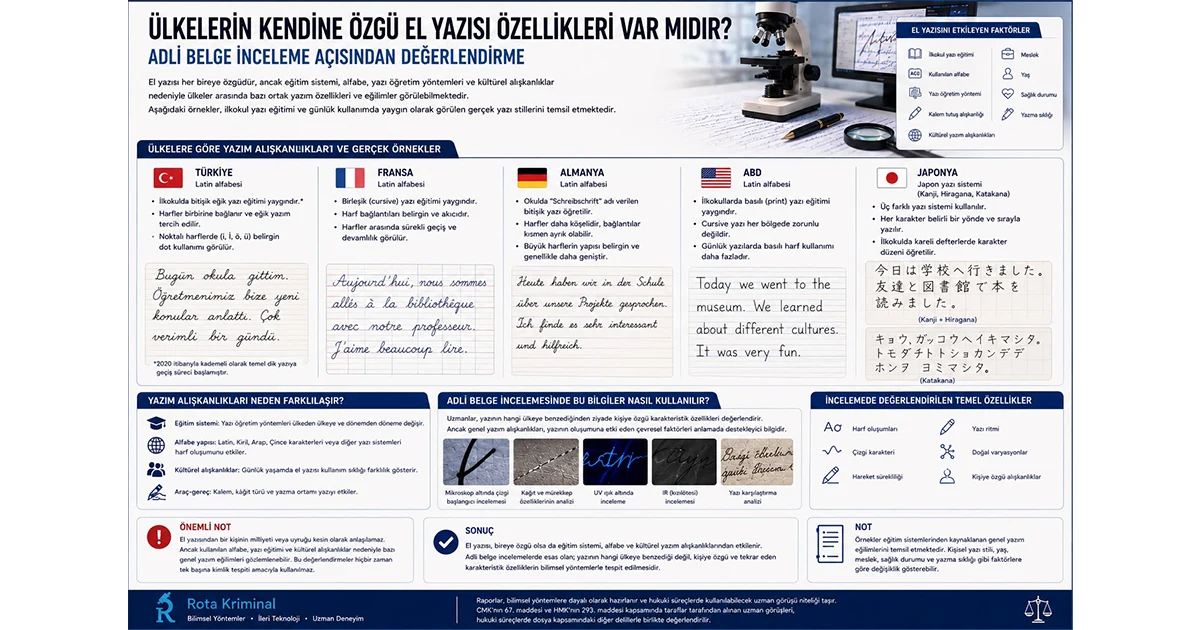
Handwriting is a unique habit that carries characteristic features specific to each individual. This does not mean, however, that people who grow up in the same country share no common features in their writing. The handwriting instruction a person receives in childhood, the alphabet used, the school curriculum and cultural writing habits all play an important role in how handwriting develops.
So, can common features be seen in the handwriting of people educated in the same country? How is this assessed in forensic document examination? The answer determines which finding carries evidential value in a handwriting examination and which is merely supporting information.
What Factors Influence Handwriting?
Handwriting is not formed by a person’s biomechanical movements alone. Many environmental and individual factors influence how writing takes shape.
Some of these are:
- Handwriting instruction at primary school,
- The alphabet used,
- The method of teaching writing,
- Pen grip habits,
- Cultural writing habits,
- Occupation,
- Age,
- Health,
- Frequency of writing
— to name a few.
For this reason, certain common tendencies can be seen in the writing of people who grew up in the same country. Distinguishing which of these tendencies come from schooling and which from the person’s own habits falls squarely within the remit of the forensic document examiner.
The Influence of Primary School Handwriting Instruction
The foundations of a person’s handwriting are generally laid in the primary school years.
Pupils are taught, according to set rules, how to form letters, where to start them, how to join letters and how to lay out their writing.
Each country — and sometimes even different curricula applied at different times within the same country — can influence writing habits.
In Türkiye, for example, upright print was taught for many years; later a slanted cursive system was introduced, followed by a return to upright print. As a result, clear differences stemming from the education system can be seen in the handwriting of people from different age groups.
Writing Habits by Country
In forensic document examination, there is no definitive concept of a “national handwriting”. However, some common writing habits can be observed as a result of different education systems.
🇹🇷 Türkiye
The Turkish alphabet is based on the Latin alphabet. Because different handwriting teaching systems have been applied at different times, a range of habits can be seen, such as:
- upright print,
- slanted cursive,
- a combination of both styles
This variety means that no single standard handwriting model can be expected in a handwriting examination carried out in Türkiye.
🇫🇷 France
In France, joined-up (cursive) handwriting instruction is widespread. As a result, the following may be more pronounced in the everyday writing of many people:
- letter connections,
- fluent writing,
- continuous pen movement
— all of which stand out more clearly.
🇩🇪 Germany
Germany has applied different handwriting teaching systems over the years. Depending on the script taught at school, the following can be seen side by side:
- joined writing,
- simplified handwriting,
- styles close to print
in everyday use.
🇺🇸 United States
In the US, print handwriting instruction has become more widespread in many schools in recent years. As a result, especially among younger people, the following are common:
- use of printed letters,
- less joined writing,
- personal style variations
This is also instructive for understanding why handwriting differs from person to person.
🇯🇵 Japan
The Japanese writing system consists of three different scripts:
- Kanji,
- Hiragana,
- Katakana
This makes writing movements and character formation quite different from those of other alphabets.
How Is This Information Used in Forensic Document Examination?
Examiners do not base their assessment during a document examination solely on which country the writing resembles. The examination is based on:
- letter formations,
- line character,
- continuity of movement,
- natural variations,
- writing rhythm,
- characteristic habits,
- individual writing features.
That said, the handwriting instruction a person received and the cultural environment in which they grew up may be among the supporting information that helps in understanding the general character of the writing. All of these elements are assessed with the help of the instruments used in examination and in a set order; the same approach applies to signature examination.
Can a Person’s Nationality Be Determined from Their Handwriting?
No.
It is not possible to state scientifically which country a person is a citizen of, or what nationality they are, from their handwriting alone.
However, based on the alphabet, education system and writing habits, technical assessments can be made as to whether the person may have received a particular kind of handwriting instruction.
These assessments are never used on their own for identification. You can find other frequently asked topics on our frequently asked questions page, and details of the scope of the examination on the handwriting examination page.
In Europe, the ENFSI European Document Experts Working Group (EDEWG) carries out work setting the criteria for reporting opinions and the quality assurance principles in forensic document examination.
In the Assessment, It Is the Person That Matters, Not the Country
Although handwriting carries characteristic features specific to the individual, it is also influenced by the education system, the alphabet and cultural writing habits. For this reason, some common tendencies can be seen in the writing of people educated in the same country.
In forensic document examination, however, what matters is not which country the writing resembles but establishing, by scientific methods, the recurring, natural characteristic features specific to the person.
This is why examiners treat general writing habits as auxiliary information in document examinations, while always basing their conclusions on individual writing characteristics and technical findings. You can also read about who can benefit from these examinations.
This approach is also governed by standards at international level. In the US, the Forensic Document Examination Subcommittee within NIST and SWGDOC publish standards defining the methods to be followed in handwriting and signature examination.
Which country a piece of writing resembles does not tell you who wrote it. What reveals identity are the details a person repeats every time without being aware of it.
Education and culture draw the frame of the writing; individual characteristics put their signature on it. Forensic document examination is reliable as long as it does not confuse the two.
A contract, a promissory note, a will or a handwritten statement… Who wrote it, and whether it was altered afterwards, can be established by scientific methods. Contact us to request an expert opinion.
Istanbul · Ankara · Adana | info@rotakriminal.com · Since 1999
Frequently Asked Questions
Do countries have their own distinctive handwriting characteristics?
In forensic document examination, there is no definitive concept of a national handwriting. However, because of the handwriting teaching system used at primary school, the alphabet and cultural writing habits, some common tendencies can be observed in the writing of people educated in the same country. These tendencies are not indicators of identity but supporting information.
How does the writing system taught at primary school affect handwriting?
The foundations of handwriting are laid in the primary school years. How to form letters, where to start them and how to join them are learned during this period. Because upright print and slanted cursive systems have been taught in Türkiye at different times, clear education-related differences can be seen in the writing of people from different age groups.
Do writing habits count as evidence in forensic document examination?
General writing habits acquired through schooling carry no evidential value on their own. The examination is based on letter formations, line character, continuity of movement, natural variations, writing rhythm and characteristic habits specific to the person. The opinion is always built on individual writing characteristics and technical findings.
Why do numerals and date formats matter in documents drawn up abroad?
Decimal and thousands separators and date order vary from country to country. An amount written as 1.500,00 in Türkiye appears as 1,500.00 under the US convention; the date 03/04/2026 means 3 April in one system and 4 March in another. In addition, writing habits such as the crossed seven can create an impression of alteration to an inexperienced reader.