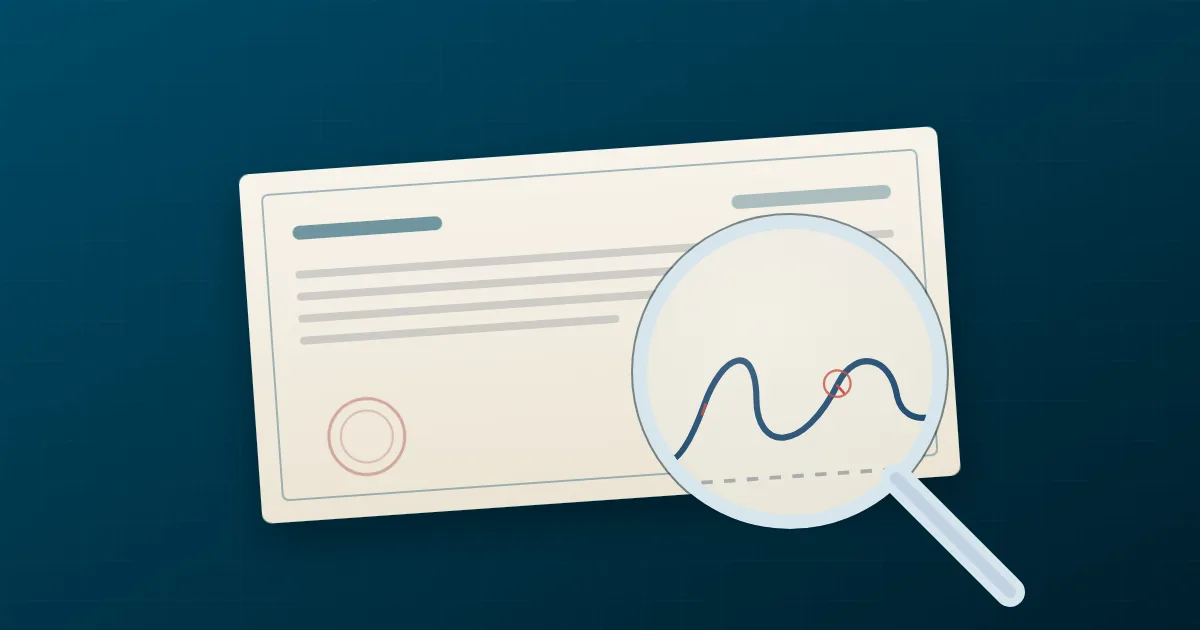
A customer hands you a post-dated Turkish cheque, or a cheque from a company you have never dealt with reaches you by endorsement. Most people ask only one question at that moment: will it clear? There is a worse possibility. The cheque leaf itself, the signature on it or the amount written in it may not be genuine. Spotting a fake cheque in Turkey does not come down to one sign; you look at the printed data on the leaf, the QR code, the amount field and the signature separately.
Below we explain the checks you can run yourself when accepting a cheque, what the QR code query shows and what it does not, and what to do with a suspicious cheque, with reference to the Turkish Commercial Code (TTK), the Cheque Law (Çek Kanunu) and the Turkish Criminal Code (TCK). Plan the legal steps with a Turkish lawyer; our field is the technical examination of the document.
In brief
- A bounced cheque (karşılıksız çek) is a genuine cheque with no funds behind it. In a fake cheque the leaf, the signature, the amount or one of the endorsements is not genuine.
- Every Turkish cheque leaf must carry the account number, branch, account holder’s name, tax number, printing date, serial number and a QR code.
- The QR code is read with the Findeks Mobile app; an ordinary QR reader does not show the cheque data.
- The QR code identifies the leaf, but it does not reveal a forged signature or an altered amount on a genuine leaf.
- Forging a cheque is punished under the rules on forgery of official documents, with two to five years’ imprisonment.
- Statutory references reflect the texts in force on 16 October 2026.
What is the difference between a fake cheque and a bounced cheque?
With a bounced cheque the document is genuine and the problem is the account. The drawer signed their own leaf, but on presentation there is not enough money in the account. The sanction is in Article 5 of the Cheque Law: on the holder’s complaint, a judicial fine and a ban on issuing cheques2.
With a fake cheque the document itself, or a statement on it, is not genuine. Because a cheque is a negotiable instrument payable to order, TCK 210/1 applies the rules on forgery of official documents; TCK 204/1 provides two to five years’ imprisonment for anyone who forges an official document, alters a genuine one to deceive others, or uses a forged one3.
The distinction also matters for the bank. Under TTK 812 the loss from paying a forged or altered cheque falls on the drawee bank, unless the person named as drawer can be blamed, for example for not keeping the chequebook safe1.
How are fake cheques made?
A fake cheque comes in one of four forms. Sometimes two of them appear on the same cheque.
- Counterfeit leaf. A leaf the bank never printed, imitating a real cheque. It is produced on a printer or with a simple printing technique; the background pattern, the typeface and the paper differ from the genuine article.
- Forged signature on a genuine leaf. A leaf torn from a stolen or lost chequebook is filled in and the account holder’s signature is imitated. The leaf, serial number and QR code are real.
- Altered amount or date. The amount on a genuine cheque is increased or the issue date is changed. Scraping, chemical erasure and added digits are the usual methods.
- Forged endorsement. The cheque is genuine, but one of the endorsements on the back was not made by the person named. It usually appears where the cheque has left the holder’s hands somewhere along the chain.
The first form can often be spotted when you accept the cheque. In the other three the leaf is genuine, so a visual check may not be enough; this is where signature and ink examination comes in.
What should I check when accepting a Turkish cheque?
Start with what must be on the leaf. TTK 780 lists the required elements of a cheque: the word “çek” in the text, an unconditional order to pay a fixed sum, the trade name of the paying bank, the place of payment, the date and place of issue, the drawer’s signature, the serial number assigned by the bank and the QR code1.
Article 2 of the Cheque Law sets out what the bank must print on each leaf: the account number, the branch name, the account holder’s name or trade name, the tax identification number, the printing date, the Turkish ID number for individuals and the MERSIS trade registry number for companies where available. If the account holder and the person signing are different, the signer’s Turkish ID number is added as well2. Chequebooks are printed by banks; there is no such thing as a privately printed Turkish chequebook.
One suspicious row does not prove the cheque is fake. If two or more rows look wrong at the same time, stop and ask questions before you accept it.
Does the QR code query catch a fake cheque?
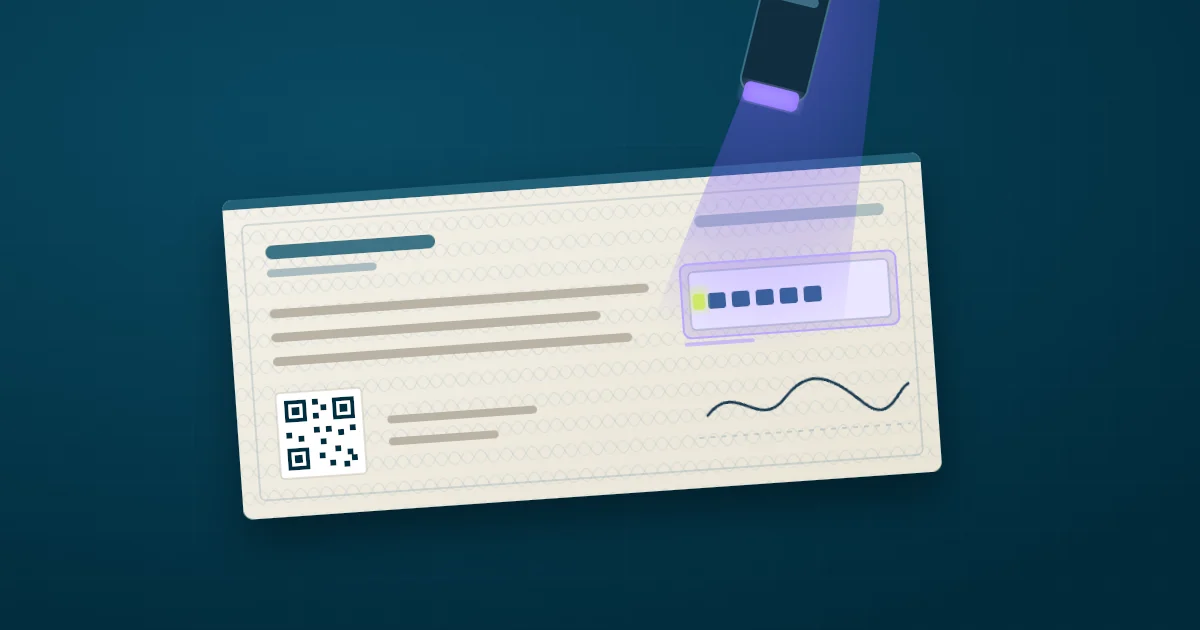
Partly. A 2016 amendment to TTK 780 made the QR code a mandatory element of every cheque, and the QR reading system was set up by the Risk Centre of the Banks Association of Turkey1. The query is run with Findeks Mobile, the app of the Turkish Credit Bureau (KKB); a phone’s ordinary QR reader does not show the cheque data. The free Findeks query shows whether the drawer is banned from issuing cheques, whether there is a bankruptcy ruling and whether a precautionary injunction is recorded for that leaf; the paid report adds the bank, the drawer’s cheque payment history and the number of open cheques4. If you have no Findeks account, your Turkish lawyer or business partner can run the query.
On a counterfeit leaf the QR code either does not read at all or points to a different account. If the data returned does not match the account holder’s name and tax number on the leaf, treat it as a serious warning. Here is the limit: the QR code knows the leaf, not what was written on it. A genuine leaf torn from a stolen chequebook reads without any problem; a forged signature or an inflated amount does not show up in this query.
Article 3/10 of the Cheque Law also requires the payee of a QR-coded cheque to register the cheque in this system once received2.
How can I tell if the amount or date has been altered?
Start by comparing the two entries in the amount field. Where the sum is given in both words and figures and they differ, the amount in words prevails (TTK 676, applied to cheques by TTK 818). Forgers know this too, so they often change both: a digit is added in front of the figure and a word such as “yüz bin” (one hundred thousand) at the end of the written amount.
The added part usually looks cramped, sits slightly off the line or has a different ink tone. Where the paper was scraped it becomes thinner, its gloss changes against the light and the bank’s background print fades at that spot. Chemical erasure can leave stains or a lightened area; some of these become visible only under ultraviolet light.
Proving the alteration has legal consequences. Under TTK 748, where the text of a negotiable instrument has been altered, those who signed after the change are liable on the new text and those who signed before it on the original text. A drawer whose 50,000 TL cheque was turned into 150,000 TL is therefore liable for the amount they actually wrote, once the alteration is proven. In our laboratory we examine ink differences, erasures and scraping with a Forenscope DocEx, digital microscopes, oblique light and UV/IR sources; see document alteration examination for the method.
How do you tell if the signature on a cheque is forged?
Not with certainty by eye. In the hands of a skilled copyist a simulated signature looks very much like the real one; the difference lies in how the line was drawn. Under a digital microscope, forged signatures often show tremor, unexpected hesitations, breaks where the pen was lifted and set down again, and a slow writing speed throughout. These findings are assessed against the person’s genuine signatures from the same period.
The most useful comparison material is signatures made at official institutions close to the date of the cheque: the bank’s signature card, notarial deeds and, for companies, the signature circular (imza sirküleri). The documents that work best and the stages of the examination are described on our signature examination page.
It also helps to know what a forged signature does to the rest of the cheque. TTK 677 provides that forged or non-binding signatures on a bill of exchange do not affect the validity of the other signatures, and TTK 818 applies this to cheques. Even if the drawer’s signature turns out to be forged, those who genuinely endorsed the cheque may remain liable; the same goes for a forged endorsement.
What should I do with a cheque I suspect is fake?
First, protect the original. The examination is carried out on the original document, and every intervention on the paper leaves a trace:
- Do not fold or staple the cheque, and do not put tape or sticky notes on it.
- Scan both sides in colour at high resolution.
- Do not write notes, initials or marks on it.
- Record in writing from whom, on what date and for what transaction you received it.
- Keep any other cheque, invoice or contract you have from the same drawer; it is useful for comparison.
Forgery is a separate offence, so a criminal complaint can be filed with the Turkish public prosecutor’s office. If you are not the holder but the person named as drawer, and enforcement proceedings have been started against you, the deadline is very short: in enforcement based on a negotiable instrument, a signature objection must reach the enforcement court within five days of service of the payment order. The deadline and the cost of the objection are explained in not your signature on a Turkish promissory note.
Decide with your Turkish lawyer which route to take and in what order. A technical examination of the cheque gives the criminal complaint and the objection a concrete basis; a party expert opinion can be filed under HMK 293 in civil proceedings and CMK 67 in criminal proceedings. Similar methods seen on promissory notes are collected in how to detect a forged promissory note.
This article is for general information and is not legal advice. Statutory references reflect the Turkish Commercial Code, Cheque Law and Criminal Code as in force on 16 October 2026; the scope of the QR code query reflects information published by Findeks on the same date.
Doubts about a Turkish cheque?
Send us a scan of both sides. We examine the signature, the amount field and the print and prepare an expert opinion that your Turkish lawyer can file.
Alteration examination Request an expert opinion +90 505 215 71 10
Istanbul · Ankara · Adana
Sources
- Turkish Commercial Code No. 6102 (TTK), Art. 676, 677, 748, 780, 812, 818. mevzuat.gov.tr
- Cheque Law No. 5941 (Çek Kanunu), Art. 2, 3, 5. mevzuat.gov.tr
- Turkish Criminal Code No. 5237 (TCK), Art. 204, 210. mevzuat.gov.tr
- Findeks, Karekodlu Çek Raporu (QR-coded cheque report). findeks.com
Frequently Asked Questions
Does a QR code scan prove a Turkish cheque is genuine?
No. The query shows which account the leaf belongs to and whether the drawer has a cheque ban, a bankruptcy ruling or an injunction on record. It does not reveal a forged signature or an altered amount on a genuine leaf.
What is the penalty for forging a cheque in Turkey?
A cheque is a negotiable instrument payable to order, so TCK 210/1 applies the rules on forgery of official documents. TCK 204/1 provides two to five years' imprisonment; knowingly using a forged cheque falls under the same provision.
Is the bank liable if it pays a forged cheque?
Under TTK 812 the loss from paying a forged or altered cheque falls on the drawee bank. The result can differ if the person named as drawer can be blamed, for example for not keeping the chequebook safe.
Can forgery be detected from a copy of the cheque?
A preliminary assessment is possible from a high-resolution colour scan. Scraping, paper surface, ink differences and pen pressure can only be examined on the original, so a firm conclusion is reached on the original cheque.