Someone stood over you while you signed. Perhaps you signed a promissory note in Turkey because you were told what would happen if you refused, or you put your name on a paper you had not read to keep your job. Now that document is being used against you, and you want to know whether a signature made under duress can be detected afterwards. Forensic document examination shows whether the signature came from your hand and how far it departs from your normal signatures. Duress itself is usually proven with evidence outside the signature. Below we explain how the two fit together under Turkish law.
At a glance
- A signature made under duress is not a forgery. You held the pen, so an examination will most likely attribute it to you.
- Fear, tension or unusual writing conditions can leave slowness, hesitation and changes in form. Age, illness, medication or an awkward posture leave the same traces.
- Under the Turkish Code of Obligations (TBK) a contract made under threat does not bind you, but you must declare this within one year of the threat ceasing to have effect (TBK 37 and 39).
- Forcing someone by violence or threat to sign a promissory note, or a paper that can later be turned into one, is robbery (yağma) under the Turkish Penal Code (TCK 148/2).
- Statutory provisions are stated as in force on 5 November 2026.
Can a signature made under duress be detected?
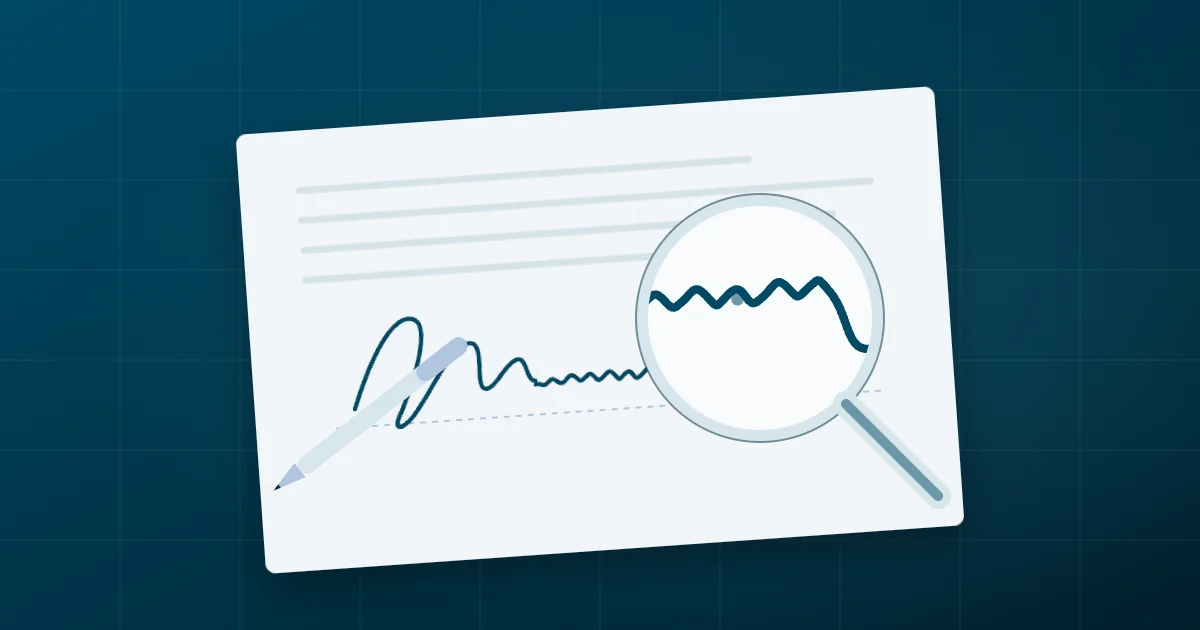
Partly. A signature examination asks two questions: who wrote the signature, and how far does it depart from the writer’s normal habits? With a signature made under duress, the answer to the first question is usually you. Your hand and the signing habit you built over years produced the movement. What the examiner can see is the answer to the second question; the signature may look as if it was written under different conditions from your natural signatures.
That difference does not prove duress on its own. In one study modelled on the signature boxes of Canadian government forms, 40 participants produced 2,400 signatures. Signing inside a narrow box was enough to change pen speed, fluency of movement and overall length significantly, while pen pressure stayed the same. The researcher also noted hesitations and signs of anxiety in some participants3. If an ordinary form box changes a signature this much, nobody can look at a single signature and say “this person was threatened”. In a report, such a deviation appears as one possible explanation among others.
How is a signature under duress different from a forged signature?
The difference lies in who signed. In a forgery someone else imitates your signature, and the examination looks for signs of simulation: carefully drawn lines, blunt starts and endings, pen lifts in the wrong places. We collected these findings in how a forged signature is detected. Under duress you sign yourself. Your claim is not that the signature is false, but that your free will was overridden by threat.
There is a third situation as well: a person signs and deliberately distorts the signature so that they can deny it later. Because a tremulous or slow line can appear in all three cases, an examiner does not reach a conclusion without placing the questioned signature next to signatures you wrote on other dates. We explain deliberate distortion in disguised signatures.
Is a signature made under duress legally valid in Turkey?
It may not bind you as a contract. Under the Turkish Code of Obligations, a party who concluded a contract because of a threat by the other party or by a third person is not bound by it. For the threat to count, you must have been justified, in your situation, in believing that a serious and imminent danger threatened the personal rights or property of you or someone close to you1. Ordinary pressure in a tough negotiation does not meet that threshold.
The deadline is the point most often missed. If you do not declare within one year, counted from the moment the threat ceased to have effect, that you are not bound by the contract, or do not reclaim what you gave, the law treats you as having ratified it1. Decide with a Turkish lawyer when and how the declaration is made.
If one party has concluded a contract as a result of a threat by the other party or by a third person, that party is not bound by the contract.
Turkish Code of Obligations No. 6098, Art. 37/1 (our translation)
Criminal law treats the matter separately. Forcing a person by violence or threat to hand over a promissory note that can put them in debt, or to sign a paper that can later be turned into such a note, is classed as robbery (yağma) under the Turkish Penal Code and carries six to ten years’ imprisonment2. Where no note is involved, the offence of threat (TCK 106) may apply. If a blank paper signed under pressure was later filled in as a promissory note, the document is also examined for alteration; see a document altered into a promissory note.
What helps to prove duress?
In most cases the evidence around the signature tells more than the signature itself. Together with your lawyer, try to gather:
- Witnesses who were present on the day and at the place of signing
- Messages, emails and call logs from before and after the signing
- Camera footage and location data
- A complaint, police report or medical report made after the event
- Other documents you were made to sign on the same day
Your lawyer will assess whether these records can be used as evidence in Turkish proceedings. The document itself can also speak. Whether the text was added after the signature, whether different pens were used on the page and whether blank spaces were filled in later are all questions for forensic document examination. The order of crossing strokes can be established on some documents, not on every one.
What should you do first if you signed under duress?
Write down what happened while you still remember it. The date, time, place, who was there and what was said to you are the details hardest to recall months later. Then take these steps:
- Get a copy or photo of the document you signed; if you cannot, note who holds it.
- Record the names and contact details of witnesses.
- Do not delete messages or call logs on your phone; back them up.
- Put the one-year deadline in your calendar and consult a lawyer in Turkey.
- Collect signed documents of yours from the same period; the examination will need them.
- If the threats continue, go to the police.
How is a signature made under duress examined?
With comparison samples. The examiner compares the questioned signature with signatures of yours from the same period that were clearly not made under pressure: bank paperwork, notarial deeds, workplace documents, official applications. The more samples there are, and the closer their dates are to the questioned document, the more clearly one can see whether the deviation falls inside or outside your normal variation.
Tell the examiner at the start about your health, any medication and the setting in which you signed (standing, at a desk, in a hurry). A trace that has another explanation will not be read in favour of duress; knowing this in advance helps you understand what the report can and cannot show. For the examination process see our signature examination page, and if a report in your file needs a scientific review, our expert opinion page. You can send documents from outside Turkey; see document examination from abroad.
This article is for general information only and is not legal advice. Statutory provisions are stated as in the Turkish Code of Obligations and the Turkish Penal Code in force on 5 November 2026.
Does your signature depart from your normal ones?
Send us a scan of the questioned document and your signatures from the same period. We report a preliminary analysis within 24 hours and, if requested, a detailed report within 48 hours, in English, German or Turkish.
Signature examination Get an expert opinion +90 505 215 71 10
Istanbul · Ankara · Adana
Sources
- Turkish Code of Obligations No. 6098, Arts. 37, 38, 39. mevzuat.gov.tr
- Turkish Penal Code No. 5237, Arts. 106, 148. mevzuat.gov.tr
- Fazio, K. (2015). The Effects of Constraint on a Signature’s Static and Dynamic Features. Journal of the American Society of Questioned Document Examiners, 18(1), 41-56. doi.org/10.69525/jasqde.214
Frequently Asked Questions
Is a signature made under duress a forgery?
No. You wrote it yourself, so the signature is yours. The legal claim is not that the signature is false but that your will was overridden by threat (Turkish Code of Obligations, Art. 37).
How long do I have to challenge a contract signed under duress in Turkey?
You must declare that you are not bound, or reclaim what you gave, within one year from the moment the threat ceased to have effect. Otherwise the contract is treated as ratified (TBK 39).
Can a signature examination prove duress on its own?
No. It shows whether the signature is yours and whether it departs from your normal signatures. The same departures can come from age, illness or writing conditions, so duress is usually proven together with witnesses, messages and records.
Is forcing someone to sign a promissory note a crime in Turkey?
Yes. Forcing a person by violence or threat to sign a promissory note, or a paper that can later be turned into one, is robbery (yağma) under Art. 148/2 of the Turkish Penal Code, punishable by six to ten years in prison.